
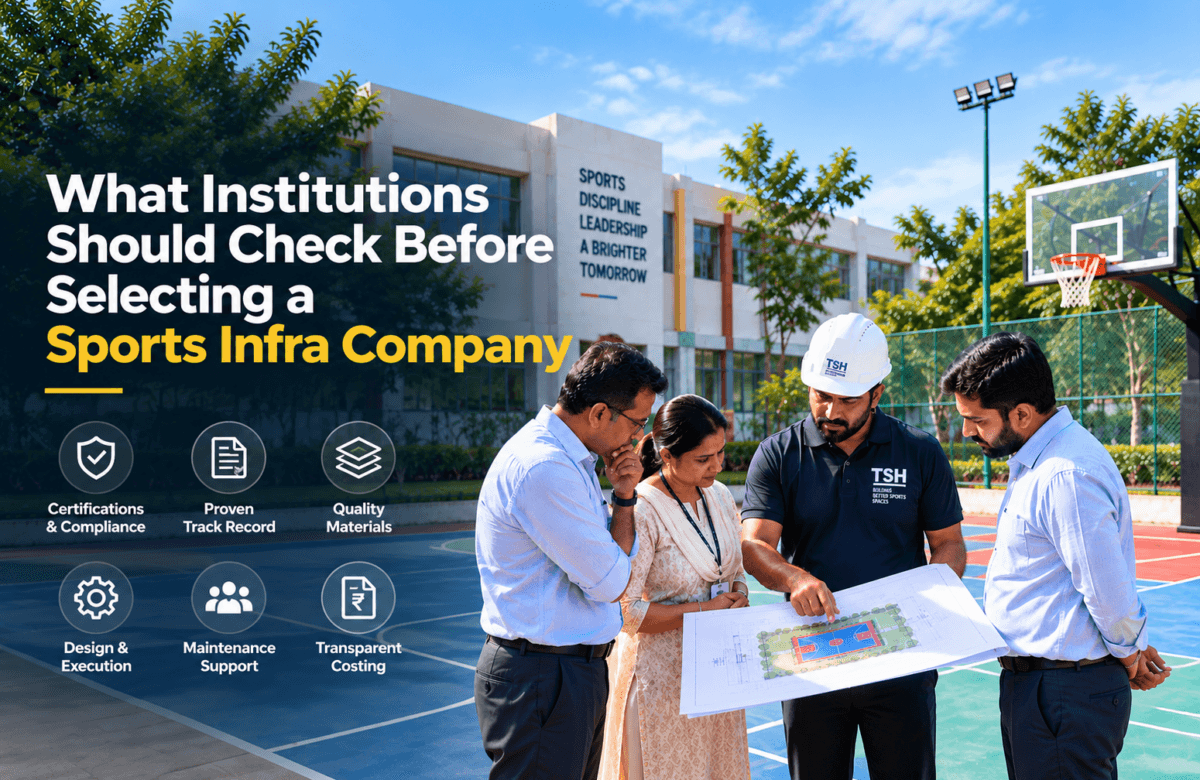
What Institutions Should Check Before Selecting a Sports Infra Company
Institutions routinely commit lakhs, sometimes crores, to a new sports facility without a vetting framework in place, and the result is predictable: surfaces that fail within a couple of seasons, timelines that stretch by months, and budgets that balloon well past the original quote. Choosing the right sports infrastructure company is the single decision that determines whether a school, college, or academy ends up with a facility that lasts fifteen years or one that needs rework after three. This is a practical checklist for exactly that decision.
In short: before hiring a sports infra company, institutions should verify certifications and compliance, review a genuine past project portfolio, confirm material quality standards, check whether design and execution both sit under one roof, understand the maintenance support on offer, and insist on transparent, itemized costing.
Why Choosing the Right Sports Infrastructure Company Matters
Get this decision wrong and the costs show up in three places. Financially, an early surface failure means paying twice, once for the original build and again for the reconstruction nobody budgeted for. On safety, a cracked or poorly drained court is a liability question waiting to happen, particularly for schools with a duty of care toward students. And reputationally, a facility that looks tired within two years undermines exactly the sports program credibility the investment was meant to build.
The upside works the same way in reverse. A well built facility supports enrollment, gives a school’s sports program real credibility, and can generate its own revenue through rentals and hosted events. Sports facility construction is not a cosmetic spend, it is infrastructure that either compounds in value or quietly erodes it.
Checklist: What to Verify Before Selecting a Sports Infra Company
Certifications and compliance
Ask which federation standards the company builds to (FIFA, ITF, IAAF, BWF, or FIBA depending on the sport) and ask to see the certification, not just hear the claim.
Past project portfolio
A portfolio should include projects similar to yours in scale and sport, ideally ones you can visit or call a reference for directly.
Material quality standards
Confirm branded, traceable materials rather than generic unbranded surfacing bought on price alone.
In house design and execution capability
A company that designs, builds, and surfaces under one roof carries single point accountability. One that subcontracts every stage has nobody clearly responsible when something goes wrong.
Maintenance support
Ask exactly what is included after handover and for how long, and get it in writing rather than assuming it is bundled in.
Transparent costing
An itemized quote separating civil work, surfacing, and add ons like fencing or lighting is a sign of a company that has nothing to hide in its pricing.
Red Flags to Watch Out For When Hiring a Sports Facility Contractor
A quote with no line item breakdown, just one lump figure
Reluctance to share references you can actually call
No mention of a maintenance plan until you ask directly
Heavy reliance on subcontractors for every stage of the project
Vague answers when you ask which specific federation standards they build to
Pressure to sign quickly, before you have compared other quotes
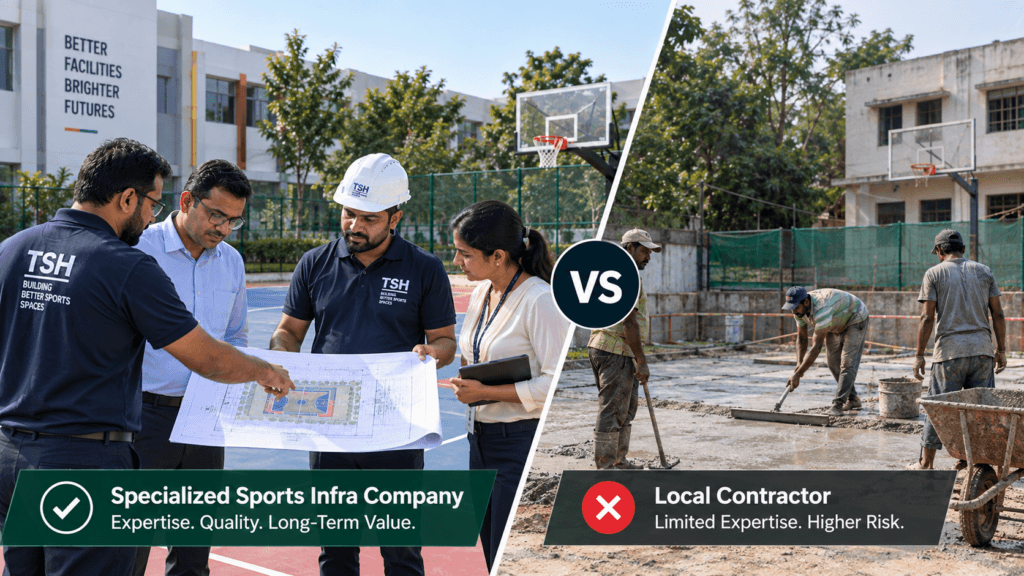
Sports Infra Company vs Local Contractor: Why It Matters
A general civil contractor can pour concrete and put up a structure. What they usually cannot do is get surface hardness, shock absorption, and federation compliant line marking right, because that knowledge sits with specialists, not general builders. This is also a category most institutions buy into once every several years, so there is little internal experience to draw on, and it is easy to judge a vendor on a polished website or a low quote rather than the signals that actually predict a project’s success.
How to Choose the Right Basketball Court Builders
Questions Institutions Should Ask Before Signing a Contract
Which federation standards does your surfacing meet, and can you show documentation?
Can we visit two or three completed projects in person?
What exactly is included in maintenance, and for how long?
Who handles the project if something goes wrong, and is that in writing?
What is your typical timeline from signing to handover?
Are civil work, surfacing, and add ons priced separately in the quote?
Searching “basketball court construction near me” is a reasonable starting point, but treat the results the same way you would any construction bid. Ask for two or three recent local references and actually call them. Visit a completed court in person rather than relying on photos. Confirm the contractor genuinely handles both outdoor and indoor builds, since many specialize in one and stretch their claims for the other. And always compare at least three itemized quotes before signing anything.
Why Maintenance Matters When Choosing a Sports Infra Company
A court is not a one time purchase, it is an asset that needs upkeep for the rest of its working life. Institutions that choose a company purely on construction price often discover the maintenance gap only after the first monsoon, when drainage issues or coating wear show up with nobody contractually responsible for fixing them. A company offering complimentary maintenance for a defined period after handover, with an optional AMC after that, is signaling that it expects its own work to hold up.
Why Institutions in Bangalore Choose The Sports Habitat
The Sports Habitat has delivered turnkey sports infrastructure for institutions including GITAM University, Amrita International Vidyalayam, and NAFL Jakkur, alongside corporate and residential clients such as ITC Limited and developers including Sattva and Mantri. Every project includes design, civil work, certified surfacing, and 12 months of complimentary maintenance under one contract, with optional AMC support available afterward. If your institution is scoping a new facility, our school project work is a useful starting reference point.
FAQ - Frequently Asked Questions
There is no single best company for every project. The right fit depends on the sport, your location, and whether you need turnkey delivery or standalone surfacing.
Certifications, a visitable portfolio, transparent itemized costing, in house design and execution, and clear maintenance terms.
Ask for documentation directly rather than relying on website claims, and cross check against the relevant federation where possible.
A specialist may quote higher upfront, but general contractors more often lead to early resurfacing or rework, which typically costs more over the facility’s lifetime.
Reputable ones do, often with a complimentary period included and an optional AMC beyond that. Confirm this in writing before signing.
A single court typically takes 4 to 8 weeks. A full multi sport facility can take several months depending on scope and approvals.
Acrylic courts typically need recoating every 3 to 4 years, with routine cleaning and drainage checks on an ongoing basis in between.
Small cracks and drainage issues left unaddressed compound quickly, often turning a minor repair into a full resurfacing job within a couple of years.
READY TO BUILD YOUR PICKLEBALL COURT?
Get a free site assessment and personalized quote from our pickleball court installation experts. From flooring selection to final line painting, we handle every step on time and within budget.