
Sports Complex Construction for Schools and Colleges: A Complete Planning Guide
Sports complex construction has moved from a campus extra to a core planning decision. NEP 2020 promotes sports integrated learning, Khelo India is funding new facilities, and parents now judge a campus by its playing fields. Boards and universities now expect real facilities, and families expect them to be safe, well lit and well kept. What is a sports complex? A sports complex is a planned cluster of indoor and outdoor facilities, such as courts, fields, tracks, halls and support areas, designed to share land, lighting, drainage and services so several sports can be played safely and maintained as one asset. This practical guide covers types, facilities, design, space, surfaces, cost, funding, approvals and how to choose a school sports facility contractor.
KEY TAKEAWAYS
- Plan the whole campus first. A master plan prevents rework when facilities arrive in phases.
- Share space. Multi sport courts and convertible turfs deliver more sport per square metre.
- Budget by facility. Costs run from about Rs 4.5 lakh for a pickleball court to crores for a 400m track.
- Base and drainage decide lifespan. Every surface depends on them.
- Funding is layered. Combine institutional budgets, CSR, schemes, alumni and partners. Confirm current terms.
- Open it up. Community access can help repay the investment.
WHAT IS A SPORTS COMPLEX?
Single sport facility
One court or field. Quick and low cost, but limited use.
Court cluster
Several courts on shared slabs, fencing and lights.
Full sports complex
Fields, courts, hall, pool and support areas on one master plan.
Why institutions build them:
- Student fitness and wellbeing, with CBSE treating Health and Physical Education as compulsory for classes I to XII
- Admission appeal for parents comparing campuses
- Inter school and inter college events
TYPES OF SPORTS COMPLEXES FOR SCHOOLS AND COLLEGES
School Sports Complex
Compact by nature: multi sport courts, a small turf, a 200m track or ground and changing rooms, built around PE periods and school events.
College and University Sports Complex
Larger and more specialised: a 400m track, full size turf, indoor hall, pool and gym for teams and tournaments.
Indoor, Outdoor and Hybrid
Outdoor suits open land and tight budgets. Indoor protects play from rain and heat. Hybrid combines both for year round use.
Community Access and Revenue Models
After hours rentals, academy tie ups and memberships help a complex earn its keep. Plan separate entry and parking from day one.
| Type | Typical facilities | Best for |
|---|---|---|
| School complex | Multi sport courts, small turf, 200m track | Daily PE and school sports |
| College complex | 400m track, full turf, hall, pool, gym | Teams and tournaments |
| Indoor hall | Badminton, basketball, table tennis | Year round use |
| Hybrid | Outdoor fields plus an indoor hall | Large campuses |
FACILITIES TO INCLUDE IN A SPORTS COMPLEX
- Athletic track: the anchor of the field zone. See our athletic track construction guide.
- Football turf: often the busiest facility. Read football turf construction in India.
- Pickleball and racquet courts: compact and popular. Check pickleball court size.
- Courts and cricket: basketball, tennis, volleyball, badminton and practice nets.
- Indoor hall, pool and gym: year round training.
- Support areas: changing rooms, washrooms, storage, seating and first aid.
Facility selection by student strength
| Students | Core facilities | Add as you grow |
|---|---|---|
| Under 500 | Multi sport courts, small turf | 200m track, indoor hall |
| 500 to 1,500 | Courts, 7 a side turf, 200m track | Hall, tennis, cricket nets |
| Above 1,500 | The above plus 11 a side turf | 400m track, pool, gym |
SPORTS COMPLEX DESIGN PRINCIPLES
Master Planning and Zoning
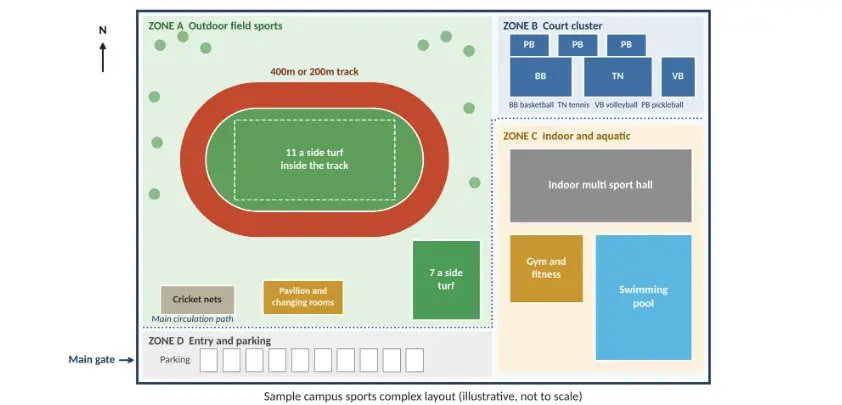
Group facilities into zones: outdoor fields, court cluster, indoor and aquatic, and entry. Reserve land for later phases.
Orientation
Run long axes of fields and courts north south to limit glare.
Multi Sport Courts Sharing Space
One slab with layered lines can serve basketball, volleyball and pickleball. This is the heart of multi sport complex design.
Safety, Run Off and Circulation
Keep run off clear, separate vehicles from players and give each zone its own entry.
Accessibility
Provide ramps, wide paths and accessible washrooms for every student.
Drainage, Lighting and Utilities
Plan drains, floodlight poles and cable ducts together so no finished surface is trenched later.
Sustainability
Use LED lighting, rainwater harvesting, permeable bases and shade trees.
SPACE NEEDED FOR A SCHOOL OR COLLEGE SPORTS COMPLEX
| Facility | Indicative area |
|---|---|
| 400m track with field | About 4 acres |
| 11 a side turf | 7,140 sq m plus run off |
| 7 a side turf | About 2,000 sq m |
| Basketball court | 28 × 15 m, at least 35 × 22 m with run off |
| Tennis court | 6,120 to 7,200 sq ft |
| Pickleball court | 167 sq m per court |
| Volleyball court | About 350 sq m with run off |
| Indoor multi sport hall | About 1,000 sq m |
| 25 m swimming pool | About 600 to 800 sq m with deck |
Indicative areas. Volleyball, hall and pool are approximate. Confirm norms with your board and local authority.
Short on land?
- Layer lines on one multi sport court instead of building three.
- Choose a 5 or 7 a side turf over a full pitch.
- Use rooftops and basements, as in our CMR National Public School court.
SURFACES AND MATERIALS
Outdoor Surfaces
Acrylic for courts, artificial turf for football, PU or rubber for tracks. Choose by sport, climate and maintenance capacity.
Indoor Surfaces
PU, modular PP tiles or wood suit halls. Basement courts need a level, crack treated base.
Fencing, Netting and Lighting
Fencing, ball stop nets and LED floodlights protect players and extend play into the evening.
| Sport | Surface | Maintenance | Lifespan |
|---|---|---|---|
| Basketball, tennis, pickleball | Acrylic | Recoat every 3 to 4 years | 8 to 10 years |
| Football | Artificial turf | Brushing, infill top ups | 8 to 10 years |
| Athletics | PU or rubber track | Low to medium | Varies by system |
| Indoor hall | PU, PP tiles or wood | Low | 8 to 12 years |
Indicative lifespans with good maintenance.
SPORTS COMPLEX COST IN INDIA
Facility mix, site condition, surface grade and certification drive the budget.
| Facility | Indicative cost |
|---|---|
| Pickleball court, outdoor | Rs 4.5 to 9 lakh |
| Basketball court, outdoor acrylic | Rs 7 to 11 lakh |
| Tennis court, acrylic turnkey | Rs 9 to 18 lakh |
| 7 a side turf | Rs 19 to 36 lakh |
| 400m track | Rs 7 to 13.5 crore |
Indicative 2026 ranges. The track figure is from public sanctions. Land, buildings, halls and pools are extra.
Funding Options
- Institutional budgets: phase the build across years.
- CSR: Schedule VII clause (vii) covers promoting nationally recognised and Olympic sports.
- Government schemes: the revamped Khelo India Scheme, approved on 31 July 2026, and UGC or Samagra Shiksha sports components. Confirm current guidelines.
- Alumni and donors: naming rights for courts and halls.
- PPP: operators or academies fund fit out in return for access.
Revenue and ROI
Rent courts after school hours, host academies and camps and sell memberships to residents. In metros, rentals of Rs 500 to 1,200 per hour can repay a well booked outdoor court in 12 to 24 months. Treat this as indicative.
APPROVALS, STANDARDS AND REGULATIONS
- Board norms: CBSE affiliation bye laws (clauses 8.6 and 8.7) set playground and 200m track expectations.
- Local approvals: land use, building plans, fire and electrical clearances.
- Sport standards: World Athletics for tracks, FIFA Quality for turf, ITF for tennis, FIBA for basketball, BWF for badminton.
- Safety and environment: fencing, emergency access, tree cutting and drainage permissions.
Rules change, so confirm with your board and local authority.
HOW TO CHOOSE A SCHOOL SPORTS FACILITY CONTRACTOR
- Finished school or campus projects you can visit
- Design and civil capability in house
- Certified surface systems
- Phased work that spares classes
- Clear warranty and maintenance terms
- Itemised pricing
Single Contractor vs Multiple Vendors
- One contractor: one point of accountability and one coordinated timeline.
- Multiple vendors: may cut item costs, but you manage clashes between civil, surfacing and electrical work.
Questions to Ask Before Signing
- Which of these facilities have you built together?
- How will you keep students safe during construction?
- What are the handover and maintenance terms?
- Who certifies the surfaces?
Speak to our sports facility construction team
Share your campus size and student strength for a phased plan. Our turnkey solutions cover design to handover.
CASE STUDY: EKYA SCHOOL, BYRATHI
| A 40,000+ sq ft multi sport complex delivered in 8 to 10 weeks | |
| Courts | 19,000 sq ft of ITF approved Courtsol France acrylic: 3 pickleball, 1 basketball, 1 volleyball and throwball |
| Turf | 10,000 sq ft FIFA compliant turf |
| Athletics | 100m IAAF approved sprint lane with a 20m deceleration zone |
| Lighting | 6 high mast poles with 72 × 400W LED floodlights at 480 lux, plus 30 ft fencing |
| Challenge | FIFA, ITF and IAAF compliance, uniform lux, limited footprint |
Also delivered
- Shridevi Institutions, Tumakuru: 20,000+ sq ft in 12 weeks, with FIFA compliant 7 a side turf and a 7+1 layer acrylic court.
- CMR National Public School: a basement indoor multi sport court in 3 to 4 weeks.
FAQ - Frequently Asked Questions
Planning and building a cluster of sports facilities with shared design, utilities and services on one site.
A compact school complex of courts and a small turf starts near Rs 40 lakh. Tracks, halls and pools push totals into crores.
A compact multi sport block fits in about an acre. A 400m track alone needs about 4 acres.
Start with multi sport courts, a turf or ground and a 200m track if land allows. Add a hall as you grow.
A site that hosts several sports through shared courts, fields and halls, planned to use land and services efficiently.
Compact complexes take about 8 to 12 weeks, as at Ekya and Shridevi. Tracks, halls and pools take months.
Affiliation bye laws require adequate playground space, including ground for a 200m track. Check the latest bye laws.
Yes, through after hours rentals, academy partnerships, camps and community memberships.
PU, modular PP tiles or wood, chosen by sport and budget. A level, crack free base matters most.
Through institutional budgets, CSR, government schemes, alumni gifts and partnerships.
Often yes. A survey shows where courts, turf and drainage can be added in phases.
Board or university norms, local building, fire and electrical clearances, plus sport specific standards.
Routine cleaning, turf brushing, court recoating every few years and lighting checks. An AMC keeps costs predictable.
A sports infrastructure specialist working with architects and engineers on the master plan, layouts and utilities.
Planning a campus sports complex?
Tell us your land, student strength and sports for a phased, costed plan.
→ Request a campus plan