
Hiring the wrong sports facility contractor costs more than any quote will show. A court that drains badly, a roof that sweats or a floor that peels fails slowly, usually after the final payment. This guide gives you a scorecard, a flag list and eight questions to separate real sports facility builders from general civil firms with a sports page on their website.
THE SHORT ANSWER
- Hire for experience on projects like yours: same sport, same size, same climate.
- Verify safety standards in writing: structure, electrical, surface and site safety.
- Judge budget fit by the itemised scope, not the lowest total.
CONTENTS
CONTENTS
Specialist or general contractor?
A sports facility construction company does three things a general builder rarely does. It reads the sport's rulebook, matches the surface to the base and stays accountable after handover.
How a good project runs, stage by stage
Strong sports facility builders show their working at every stage. Use this as your own checkpoint list.
The 100 point contractor scorecard
Score each shortlisted firm out of 100. Score on evidence, not on the sales pitch.
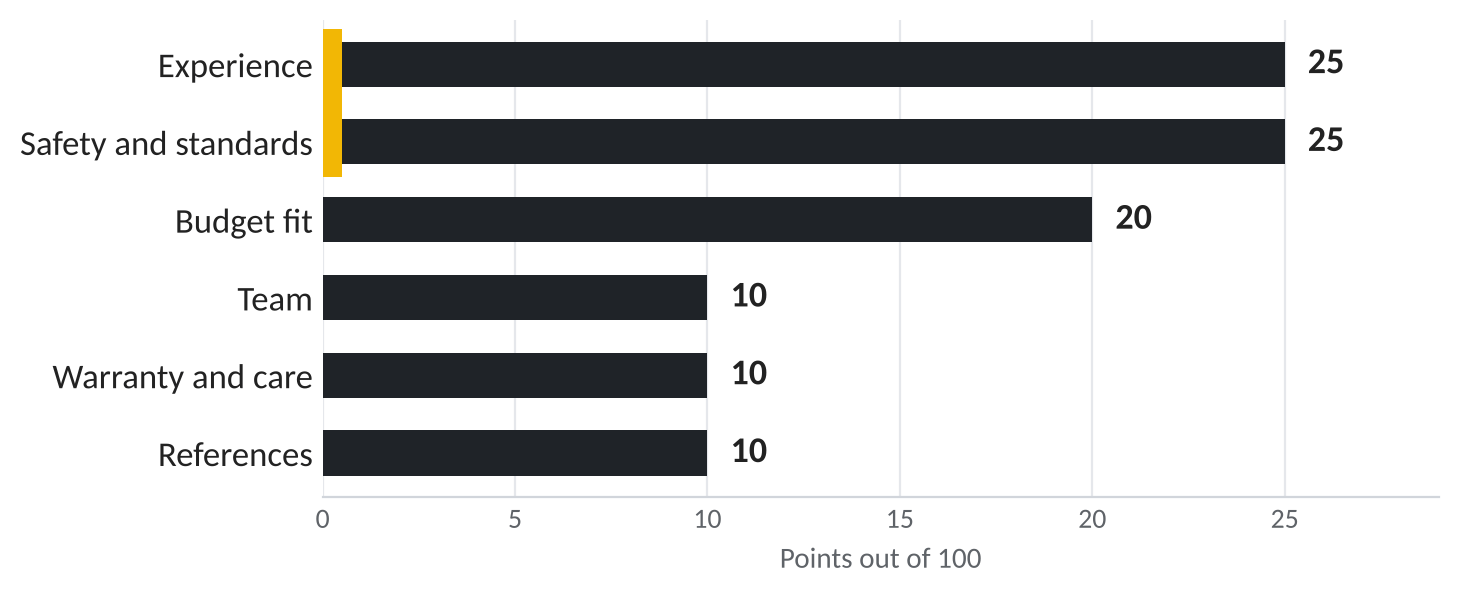
How the 100 points are split
Experience: what to verify
- Similar projects. Ask for three in your sport and size, not a long logo list.
- Own crew or subcontractors. Know who actually lays the floor and wires the lights.
- Site visits. Walk a court that is three years old, not three weeks old.
- Climate knowledge. Bengaluru rain, Rajasthan heat and coastal humidity each change the specification.
- Handover record. Ask how many projects finished on the original date.
Reference trick
- Ask for one reference from a project that went wrong. How a contractor fixed it tells you more than ten perfect ones.
Safety standards you cannot compromise on
Ask which IS codes and federation rules the design follows, and get the answer in writing.
Budget fit: indoor sports facility construction costs
Indoor sports facility construction costs swing mostly on the roof and structure, which can take 40 to 50% of an indoor project. Use these indicative 2026 ranges to sanity check a quote, then ask for rates on your own site. For a worked example, see our indoor badminton court construction guide.
Indicative ranges from public vendor guides. Land is extra.
Where cheap quotes hide cost
Line up three quotes on one sheet. Compare scope first and price second. Print this grid and fill in one column per contractor.
Think lifecycle, not just build
- A cheaper surface or structure can raise maintenance and repair bills for years. Ask each firm for a five year care estimate next to the build price.
Contract clauses worth having
- Milestone payments. Release money against finished work, not calendar dates.
- Defects liability period. The contractor fixes faults at its own cost for an agreed time.
- Delay clause. A clear penalty or credit if the programme slips.
- Variation process. Every change is priced and approved in writing before work starts.
- Handover tests. Levels, slip resistance and light readings recorded on the day.
- Retention. A small share of the price is held back until faults are cleared.
Mistakes buyers make
- Calling contractors only at tender stage, when the design is already fixed.
- Choosing on price alone and ignoring gaps in scope.
- Skipping the visit to a finished project.
- Treating the warranty as a brochure line instead of a signed document.
- Forgetting running costs such as power, cleaning and resurfacing.
Green flags and red flags
GREEN FLAGS
- Itemised quote with quantities and brands
- Site visit before pricing
- Shares drawings and method statements
- Names the project manager
- Warranty terms in writing
- Suggests a maintenance plan
RED FLAGS
- Lowest quote by a wide margin
- Cannot share recent references
- Vague lines such as "court work"
- Skips soil and drainage checks
- Asks for a large advance
- Pushes one material for every sport
Eight questions to ask before you sign
- Which three projects are closest to mine in sport, size and climate?
- Who is my single point of contact, and who supervises on site?
- Which standards will the design follow, and can I see the certificates?
- What exactly is excluded from this price?
- How are payments tied to milestones?
- What do the warranties cover, and for how long?
- What happens if the site has soft soil or drainage trouble?
- Who looks after the facility after handover?
For a wider view, read our checklist for choosing a sports infrastructure company and our guide to sports complex construction for schools and colleges.
Why choose The Sports Habitat
The Sports Habitat is a Bengaluru based sports infrastructure company with 45+ facilities delivered across India. We plan, build and look after facilities under one roof.
- One accountable team. Our turnkey solutions cover planning, design, build and handover.
- Standards first. We follow BWF norms, IS safety standards, EHS protocols and federation standards.
- Honest costing. Technical consultation starts with lifecycle cost, not only the build price.
- Care after handover. Projects include 12 months of complimentary maintenance, with an optional maintenance plan.
Planning a sports facility?
Tell us your sport, site and budget. We will come back with a scoped, itemised estimate.
→ Talk to our teamSports facility contractor FAQs
How do I choose a sports facility contractor?
Shortlist firms with similar completed projects, score them on experience, safety and budget fit, visit one site and compare itemised quotes. Choose the best value, not the lowest price.
What does a sports facility construction company do?
It plans, designs and builds courts, fields, tracks and indoor halls. The work covers site preparation, base, structure, surface, lighting and equipment, and often maintenance.
How much does indoor sports facility construction cost in India?
A single indoor court typically costs Rs 25 lakh to 1.2 crore, depending on floor and structure. Multicourt academies run from about Rs 80 lakh to 2.5 crore.
What certifications should a sports contractor have?
There is no single licence. Look for authorised installer status from manufacturers, material test certificates, a structural engineer's sign off and compliance with BWF, ITF or FIBA specifications.
How long does a sports facility take to build?
An outdoor court on a prepared site can take 2 to 6 weeks. Indoor halls with structure take longer, so ask for a dated programme with milestones.
What is the difference between sports facility builders and general contractors?
Sports facility builders know federation specifications, surface systems and sports specific safety. General contractors handle civil work well but often subcontract the playing surface, which splits responsibility.
How do I compare sports contractor quotes?
Put each quote in one grid. Compare scope, exclusions, brands, programme, payment milestones and warranty before you look at the total price.
Why is the cheapest quote risky?
It often leaves out base work, drainage, lighting or approvals, so the real cost appears later. Compare scope line by line before price.