
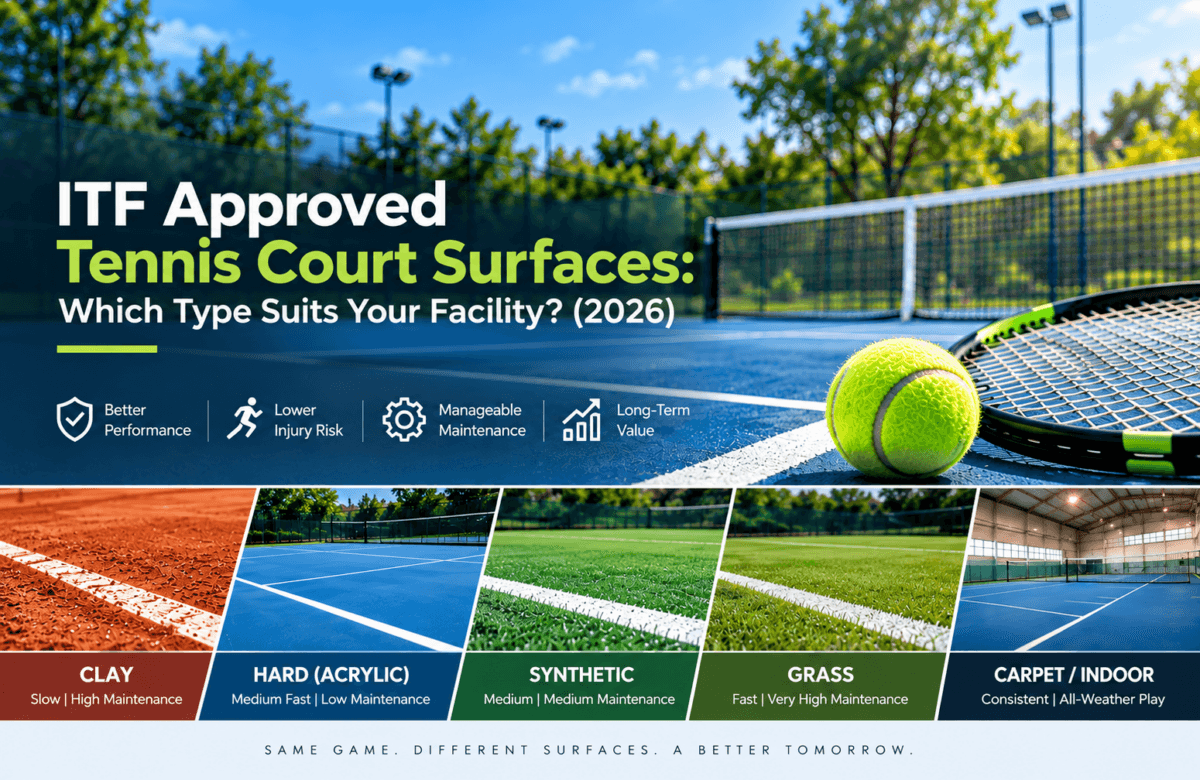
ITF Approved Tennis Court Surfaces: Which Type Suits Your Facility?
Surface choice affects far more than how a tennis court looks. It shapes player performance, injury risk, ongoing maintenance cost, and whether the court holds up in your local climate at all. The International Tennis Federation runs the global benchmark for classifying these surfaces, and understanding it properly, rather than trusting whatever a supplier’s brochure claims, is the difference between a court that suits your facility and one you are stuck living with for a decade.
In short: the ITF classifies tennis court surfaces by pace into five categories, from clay (slow) through hard or acrylic (medium to medium fast), synthetic or carpet (medium), up to grass (fast). The right choice depends on your facility type, local climate, maintenance capacity, and player level. Acrylic hard courts remain the most popular choice in India for academies and clubs, largely because they combine durability with low upkeep.
What Does ITF Classified Actually Mean?
Here is the detail most suppliers skip: the ITF’s own technical documentation states plainly that classification does not imply any form of ITF approval or endorsement. What actually happens is that a surface product is tested by an accredited lab using a ball projecting apparatus that measures friction, energy restitution, topography, and consistency, producing a single number called the Court Pace Rating, or CPR. That number places the surface into one of five categories: Category 1 (slow), Category 2 (medium slow), Category 3 (medium), Category 4 (medium fast), and Category 5 (fast).
Clay typically lands in Category 1. Grass and carpet surfaces typically land in Category 5. Most acrylic hard courts sit somewhere in the Category 2 to 4 range, which is exactly why they suit such a wide variety of facilities. For a club or academy hosting rated matches, checking a surface against the ITF’s actual published list matters more than trusting a sales pitch that name drops the word approved.
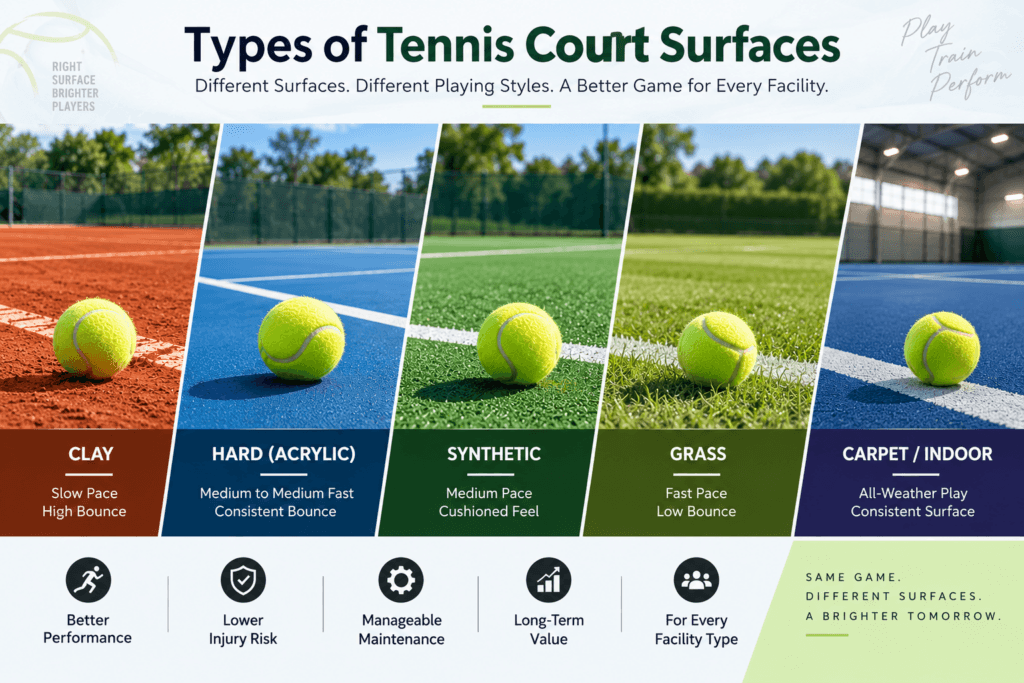
Types of Tennis Court Surfaces
1. Clay Courts
Slow pace, high bounce, and genuinely gentler on player joints, which is why academies focused on technique and endurance training favor it. The tradeoff is maintenance: daily rolling and watering, with annual resurfacing touch ups, and a real vulnerability to India’s monsoon season.
2. Hard Courts (Acrylic)
Medium fast pace with a consistent bounce, and by far the most common choice across Indian schools, clubs, and multipurpose facilities. Maintenance sits at low to medium, mostly occasional recoating, which is a large part of why acrylic dominates the best tennis court surface conversations in India.
3. Synthetic or Artificial Turf Courts
Medium pace with a cushioned, shock absorbing feel underfoot. These suit recreational clubs and residential communities well, with medium maintenance centered on sand infill top ups and regular brushing.
4. Grass Courts
Fast pace, low bounce, and the traditional Wimbledon style surface. Maintenance is very high and entirely weather dependent, which makes grass a rare, niche, prestige choice in India rather than a practical one for most facilities.
5. Carpet or Indoor Modular Courts
Consistent play regardless of weather, since the surface sits indoors entirely. Best suited to indoor academies and centers that need year round training regardless of season.
Surface Comparison Table
| Surface | Pace | Maintenance | Best For | Approx Cost |
|---|---|---|---|---|
| Clay | Slow | High | Academies | Rs 24 to 38 lakh |
| Hard (Acrylic) | Medium to Medium Fast | Low to Medium | Schools and Clubs | Rs 9 to 18 lakh |
| Synthetic | Medium | Medium | Residential and Recreational | Rs 12 to 25 lakh |
| Grass | Fast | Very High | Premium Clubs | Priced per project |
Surface Comparison Table
Schools and academies pursuing genuinely competitive training programs benefit from checking classification directly. Clubs and tournament venues hosting rated matches often need a compliant surface as a condition of hosting. Residential and community facilities generally care more about durability and consistent play than formal classification. Corporates adding a court as a wellness amenity rarely need classification at all, since the priority there is reliability, not tournament compliance.
How to Choose the Right Surface for Your Facility
1. Consider your primary user base.
Junior academy training, recreational members, and competitive tournament players all want different things from a surface.
2. Factor in local climate.
Rainfall, humidity, and temperature swings rule some surfaces out before cost even enters the conversation.
3. Assess your maintenance budget and staff.
Clay looks appealing until someone has to roll and water it daily.
4. Check certification requirements early.
If you plan to host rated events, confirm the surface’s classification before construction, not after.
5. Decide indoor or outdoor placement.
This affects both surface choice and total cost more than most people expect going in.
What Is the Best Surface for Your Facility Type?
Schools and academies
Acrylic hard court, for durability and low upkeep
Clubs and competitive training
Acrylic or synthetic clay, depending on training focus
Residential and community courts
Synthetic or acrylic, for consistent low maintenance play
Indoor facilities
Carpet or indoor acrylic systems, for year round use
Cost Considerations Across Different Surface Types
A turnkey acrylic hard court typically runs 9 to 18 lakh rupees depending on city and how much run off space is included. Clay courts cost considerably more to build correctly, often 24 to 38 lakh rupees, and carry ongoing costs that acrylic simply does not. Synthetic turf courts land somewhere in between depending on flooring grade. Across every surface type, the base underneath matters more than the surface on top. A strong base under a modest surface consistently outlasts a premium surface poured over a weak one. For a deeper look at why bases fail and what that costs you later, see our guide on why most outdoor sports courts fail within a few years.
Common Mistakes to Avoid When Choosing a Surface
Picking a surface based on price alone, without checking climate fit
Assuming a surface is tournament ready without confirming its actual classification
Underestimating the maintenance commitment, especially with clay
Hiring a general contractor unfamiliar with surface specific installation requirements
Questions to Ask a Tennis Court Construction Company
Is this surface ITF classified, and for which pace category?
What is the expected lifespan of this surface in our local climate?
What does the ongoing maintenance schedule actually look like?
Can you show past projects using this exact surface type?
Do you offer AMC or maintenance support after construction?
Why Choose The Sports Habitat as Your Tennis Court Builder
The Sports Habitat supplies and installs ITF classified surfacing systems as part of its certified sports systems service, alongside FIFA, IAAF, and BWF compliant materials for other sports. Looking for tennis court builders near you in Bangalore? Our team handles everything from surface selection through civil work and final line marking under one contract.
FAQ - Frequently Asked Questions
It is a surface tested by an ITF accredited lab and assigned a Court Pace Rating, placing it into one of five pace categories. The ITF itself notes this classification does not amount to formal approval or endorsement.
Acrylic hard courts, for their combination of durability and manageable maintenance across a wide range of climates.
Clay is slow with a high bounce and heavy upkeep. Hard courts are medium fast with low to medium upkeep. Synthetic surfaces sit in the middle on both pace and maintenance.
Acrylic hard courts typically run 9 to 18 lakh rupees. Clay courts often run 24 to 38 lakh rupees given their more demanding base and drainage requirements.
Acrylic hard courts, by a clear margin, which is the main reason they dominate the Indian market.
Often yes, particularly between synthetic and acrylic systems, though the base underneath needs assessment first to confirm it can support the new surface.
There is no single best surface. Acrylic suits most Indian facilities, clay suits technique focused academies, and grass suits prestige or heritage venues.
Clay, hard or acrylic, synthetic or artificial turf, grass, and carpet or indoor modular systems can all carry an ITF classification, depending on the specific product tested.
Many branded acrylic systems are, though classification applies to the specific tested product, not to acrylic as a category, so always confirm the exact product.
READY TO BUILD YOUR PICKLEBALL COURT?
Get a free site assessment and personalized quote from our pickleball court installation experts. From flooring selection to final line painting, we handle every step on time and within budget.