
Why Most Outdoor Sports Courts Fail Within 3 to 5 Years (And How to Prevent It)
Why Most Outdoor Sports Courts Fail Within 3 to 5 Years
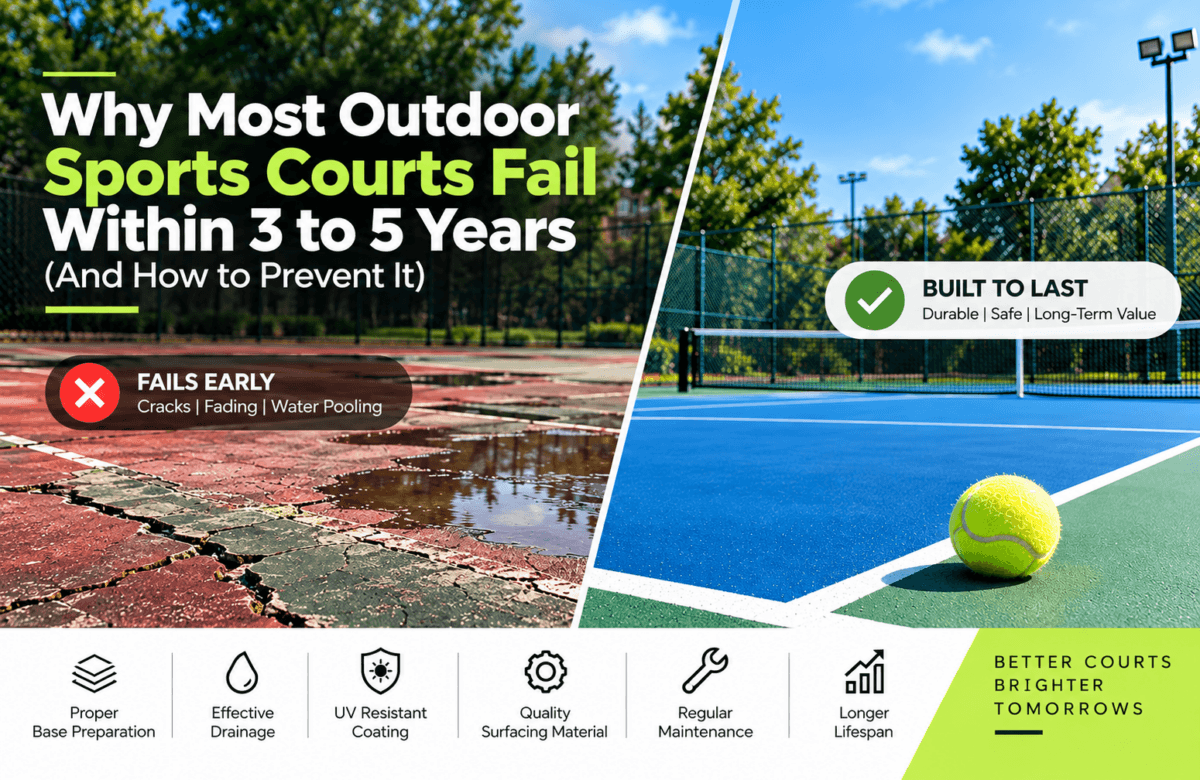
An institution spends lakhs on a new court, and within a couple of seasons the surface is cracking, the color is fading, and water is pooling in the corners after every rain. This happens far more often than it should, and almost never for the reason people assume. This guide walks through the real causes of early court failure and what proper sports court surfacing actually looks like when it is done right.
In short: most outdoor sports courts fail within 3 to 5 years due to poor base preparation, low quality surfacing material, inadequate drainage, missing UV resistant coating, and skipped maintenance. Proper sports court surfacing paired with a regular resurfacing schedule can stretch a court’s working life to 8 to 10 years or more.
The Real Cost of Early Sports Court Failure
The financial angle is the most obvious one: rebuilding a court that should have lasted a decade costs far more than building it correctly and maintaining it once every few years. The safety angle matters just as much. Cracked surfaces are a genuine injury risk, and for schools and institutions, that translates directly into liability exposure. Reputationally, a facility that looks tired within two years quietly undermines the credibility of the sports program it was meant to support.
Top Reasons Outdoor Sports Courts Fail Early
1. Poor Base and Subbase Preparation
This is the hidden cause behind most failures. Skipped soil compaction and uneven grading lead directly to cracking, sinking, and surface instability later. One tennis specific cost breakdown puts it bluntly: roughly 80 percent of court problems trace back to what happened, or did not happen, at the base stage, long before any surfacing went down.
2. Low Quality or Incorrect Surfacing Material
Unbranded acrylic or synthetic coatings, or a surface type mismatched to local climate and usage, wears out far faster than a properly specified system. This is the single factor sports court surfacing decisions most directly control.
3. Inadequate Drainage
Standing water after rain causes surface lifting, cracking, and algae growth, and it is especially damaging in monsoon prone Indian cities. Parts of the country sit on black cotton soil, which expands and contracts with moisture by as much as 15 percent and can crack an untreated slab within two or three monsoon cycles.
4. Skipping UV Resistant Coating
Sun exposure causes fading, brittleness, and gradual surface degradation. This shows up most in courts built with budget grade paint instead of a proper multi layer acrylic system, and it is one of the most common corners cut on price sensitive projects.
5. Lack of Regular Maintenance
No AMC, no resurfacing schedule, and small cracks that sit unaddressed until they become structural problems rather than cosmetic ones.
6. Heavy Usage Without Load Consideration
A court designed for casual weekend use but subjected to daily institutional or tournament traffic wears out its surface far faster than the same material would under lighter use, simply because the base underneath was never reinforced for that load.
7. Hiring Non Specialized Contractors
General civil contractors without sports court experience routinely cut corners on material specs, curing time, and layering sequence, all of which are invisible in a finished court until the surface starts to fail.
Warning Signs Your Court Is Failing
Visible cracks or bubbling on the surface
Water pooling anywhere after rain
Fading or peeling coating
Uneven bounce or inconsistent ball behavior
Line markings fading faster than the surface around them
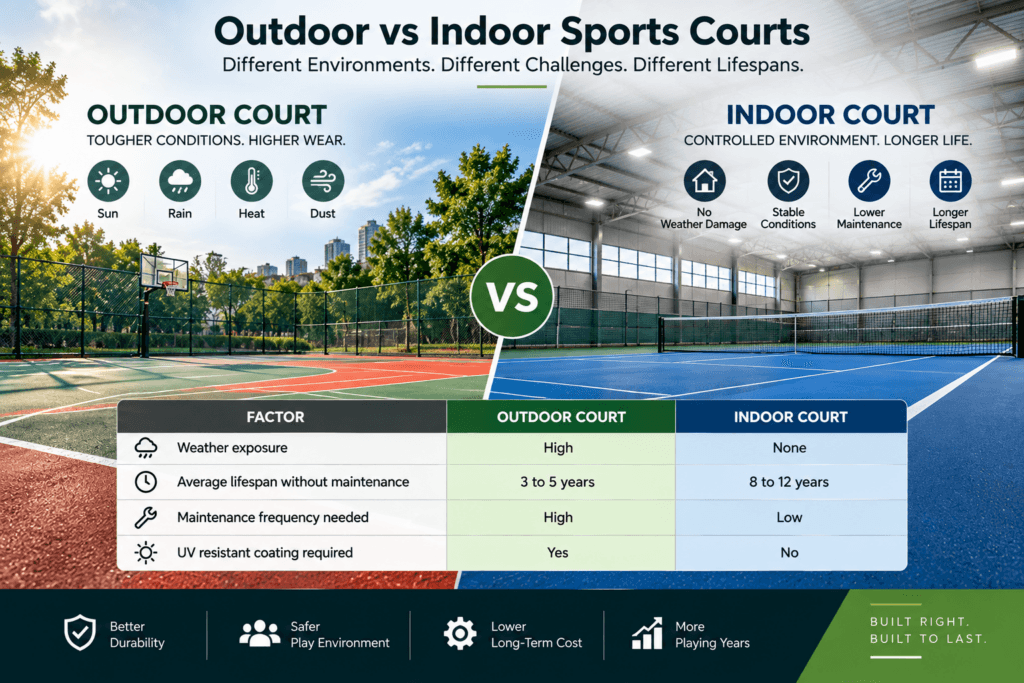
Outdoor vs Indoor: Why Outdoor Courts Fail Sooner
Outdoor Court
Indoor Court
How Proper Sports Court Surfacing Prevents Early Failure
A correctly built system is layered: a base coat, a cushioning layer where needed, a texture coat, and a UV resistant top coat, each one cured fully before the next goes on. Certified materials and correct curing time matter enormously here, and professional installation consistently outperforms a shortcut or DIY approach precisely because the layering sequence is what most budget installations get wrong. For more on how surface choice interacts with all of this, see our guide on ITF classified tennis court surfaces.
Court Resurfacing: When and How Often
Signs it is time to resurface rather than rebuild entirely include fading, minor surface cracking, and reduced grip, as long as the base underneath remains structurally sound. Resurfacing typically costs a fraction of full reconstruction, which is exactly why catching problems early pays off.
Maintenance Checklist to Extend Your Court’s Lifespan
- Regular surface cleaning to remove debris, algae, and moss
- Crack sealing at the very first sign of damage, not after it spreads
- Annual drainage inspection, especially before monsoon season
- UV recoating on schedule rather than only when damage is visible
- An AMC with a specialized contractor rather than ad hoc repairs
Questions to Ask Before Building or Resurfacing Your Court
- What sports court surfacing system do you use, and is it suited to our climate?
- What is the expected lifespan of this surface with proper maintenance?
- Do you offer AMC or a defined resurfacing schedule after installation?
- What drainage design will you implement for our specific site?
- Can you show examples of courts you have resurfaced or repaired?
Why Choose The Sports Habitat for Sports Court Construction and Resurfacing
The Sports Habitat’s maintenance strategy is built around prevention rather than reaction, covering turf, courts, lighting, equipment, and structures across every project. Every build includes 12 months of complimentary maintenance, with certified materials and optional AMC support beyond that. Looking for sports court resurfacing contractors near you? Our team specializes in diagnosing exactly which of the causes above is behind a failing surface, rather than defaulting straight to a full rebuild.
FAQ - Frequently Asked Questions
Most often a combination of poor base preparation, inadequate drainage, low quality surfacing, and skipped maintenance, rather than any single cause acting alone.
With proper construction and a regular resurfacing schedule, 8 to 10 years or more. Without maintenance, many outdoor courts fail within 3 to 5 years.
Acrylic hard courts typically need recoating every 3 to 4 years, synthetic or PU systems every 4 to 6 years, and clay courts need annual touch ups.
There is no single best material. Acrylic suits most Indian climates and usage levels, while synthetic and PU systems suit specific sports and higher cushioning needs.
Resurfacing typically costs a fraction of a full rebuild, provided the base underneath is still structurally sound.
Yes, significantly. Standing water weakens the base, accelerates cracking, and encourages algae growth, and it is one of the most common preventable causes of early failure.
READY TO BUILD YOUR PICKLEBALL COURT?
Get a free site assessment and personalized quote from our pickleball court installation experts. From flooring selection to final line painting, we handle every step on time and within budget.