
The types of running track you can build range from a mown grass loop to a factory made rubber roll worth crores. The surface decides how an athlete feels every stride: how much it cushions, how much energy it returns and how it behaves in rain. This guide breaks down the running track surfaces in use today, with lifespan, running track material cost and a clear way to choose.
QUICK ANSWER
- Natural and asphalt tracks are the old guard and rarely suit new builds.
- Modern running track surface types are spray coat, sandwich, full pour polyurethane and prefabricated rubber.
- Schools pick spray coat or acrylic. Clubs pick sandwich. Competition venues pick full pour or prefabricated.
400 m
standard track length
1.22 m
competition lane width
4
main synthetic systems
5 to 15 yrs
life before resurfacing
ON THIS PAGE
ON THIS PAGE
Types of running track at a glance
Five dots is best in every column. Read across a row to see the trade off.
Editorial ratings based on manufacturer and industry sources.
The old guard: natural and asphalt tracks
- Grass. Soft and forgiving, but uneven, weather dependent and rarely used for competition.
- Cinder and clay. Crushed stone, brick or ash. Moderate cushion, but muddy when wet and now mostly seen at older grounds.
- Asphalt bound. Smooth and predictable, but hard on joints, hot in summer and harder with age. Not recommended for new serious tracks.
What sits under every running track surface
A great surface on a weak base still fails. Every synthetic system depends on the same foundation.
- Compacted sub grade. The natural soil, tested and treated so it cannot settle.
- Granular sub base. Compacted stone layers that carry load and spread water.
- Asphalt or concrete base. Dense, even and graded to drain, because the surface copies every flaw beneath it.
- Edge drains and kerb. They carry water away and hold the surface edge.
Poor installation can shorten surface life sharply, so choose an experienced installer. Our guide to choosing a sports facility contractor shows how.
Four synthetic running track surface types
The base stays the same. What changes is the build on top.
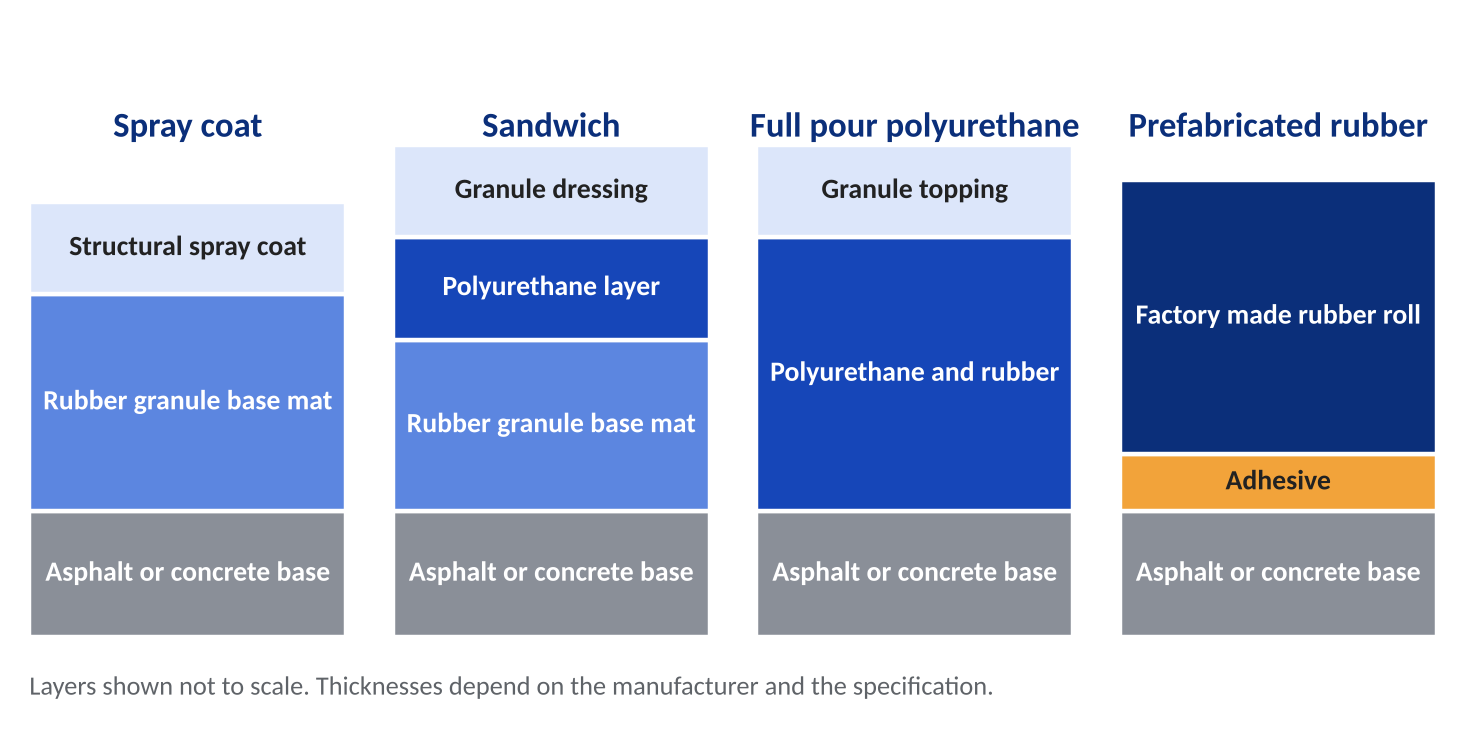
Layer build of the four synthetic systems, drawn side by side
Spray coat system
BUDGET FRIENDLYSandwich system
MID RANGEFull pour polyurethane
COMPETITION GRADEPrefabricated rubber
PREMIUM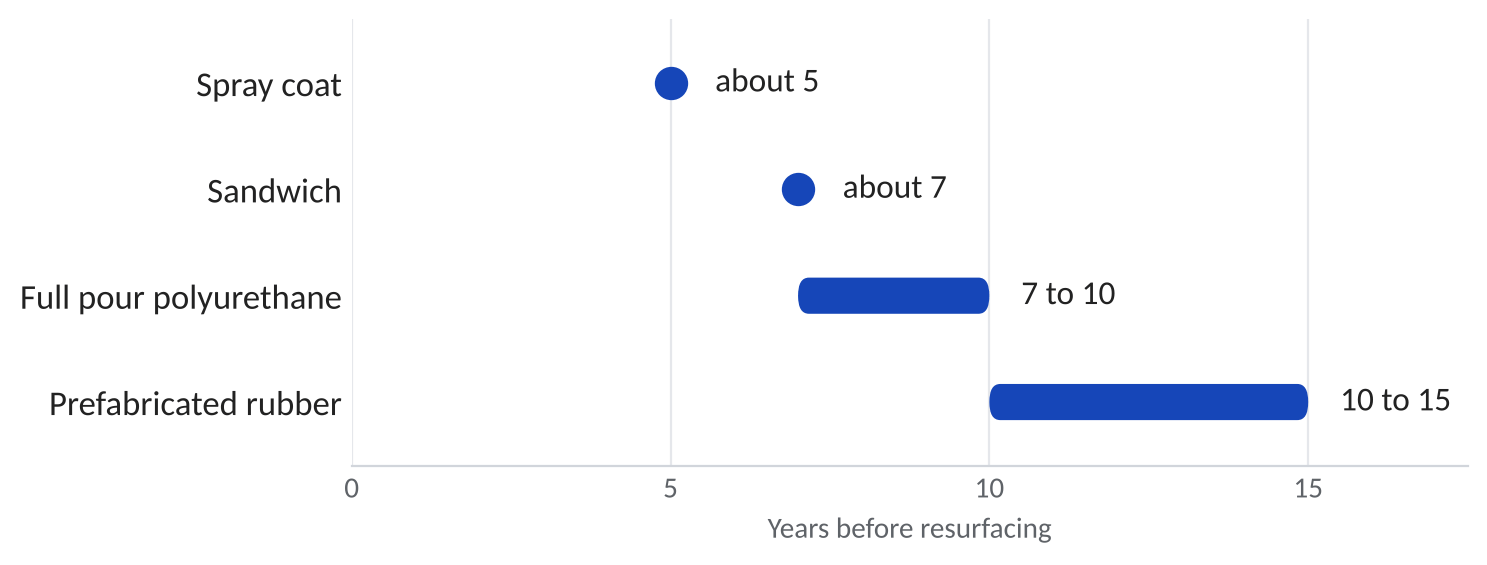
Typical years before resurfacing
Porous or nonporous: which suits your climate?
Running track material cost
Indian vendor ranges for the surface layer alone look like this. They exclude the base, drainage, kerbs and markings.
Indicative figures from Indian vendor guides. Use your supplier's quote for planning.
Worked example
- A six lane 400 m ring is about 2,900 sq m of surface.
- Acrylic at the ranges above: about Rs 17 to 35 lakh.
- PU rubber: about Rs 52 lakh to 1 crore.
- Complete tracks cost more because base and drainage sit under the surface. Vendors quote Rs 60 lakh to 1.2 crore for acrylic and Rs 1.5 to 3.5 crore for competition PU.
For scale, one European manufacturer puts the surface layer at EUR 30 to 50 per sq m including line markings. Four things move the total: size and layout, the system chosen, the substructure and the site itself.
What else adds to the bill
- Drainage, fencing, lighting, storage and spectator areas.
- Design fees, permits and inspections.
- Removing the old surface, which can be costly. A respray or retop may avoid it.
- Yearly maintenance and repairs. A cheaper track can cost more to keep.
New build or renovation?
Renovation is usually cheaper because the existing base can often be reused. Typical work includes retopping, repairing damaged areas, fresh line markings and partial or full resurfacing. The track's condition decides the final bill.
How the surface shapes performance
Cushioning
Absorbs impact so legs recover faster in training.
Energy return
Polyurethane systems give a firm feel with a slight spring.
Traction
Good grip for spikes, with spike length limits set by the facility.
How to choose the right surface
Certification note
- World Athletics Class 1 certification lasts 10 years with a possible 2 year extension, and site testing repeats after 5 years. Plan for it if you will host meets.
Ask your supplier for
- The binder type and whether the system is porous or nonporous.
- Layer thickness in millimetres, written into the contract.
- A World Athletics certificate if you will host recognised meets.
- Warranty terms and the resurfacing interval they assume.
- Two similar tracks you can visit.
Outdoor and indoor track types
- Outdoor 400 m track. Two 84.39 m straights and two curves with a 36.80 m inner radius. Competition tracks have 8 lanes of 1.22 m.
- Indoor 200 m track. Half the circumference, so the curves are banked, up to 18 degrees, to handle the tighter radius.
- Training loops. Shorter rings with a spray coat or acrylic finish suit schools and housing societies.
Care and resurfacing
- Deep clean at least twice a year with track friendly products.
- Set spike length limits and rotate training lanes.
- Repair cracks and bubbles early, because delay raises cost.
- Follow the supplier's maintenance schedule and adjust it for rain and heat.
Our running track maintenance guide covers inspection routines in more detail. Planning a new ring? Read the athletic track construction guide.
Why choose The Sports Habitat
The Sports Habitat designs, supplies and installs sports surfaces across India, then looks after them. We help you match the system to your users, climate and budget.
- Specification support. Technical consultation compares systems on lifecycle cost.
- Supply and install. See sports systems and surfaces supply.
- Care plans. Our maintenance plans protect the surface after handover.
Choosing a track surface?
Share your site, users and budget. We will recommend a system and an itemised cost.
→ Talk to our teamRunning track surface FAQs
What are the types of running track surfaces?
The main types are natural (grass, cinder, clay), asphalt and synthetic systems. Synthetic systems are spray coat, sandwich, full pour polyurethane and prefabricated rubber.
What is the best surface for a running track?
Full pour polyurethane or prefabricated rubber suits competition. Sandwich systems balance cost and performance for clubs. Spray coat and acrylic suit schools and training.
What is a running track made of?
Most modern tracks use rubber granules bound with polyurethane over an asphalt or concrete base. Some use acrylic coats or prefabricated rubber rolls.
How much does a running track cost?
Indian vendors quote Rs 600 to 1,200 per sq m for acrylic and Rs 1,800 to 3,500 per sq m for PU rubber, surface only. Complete 400 m tracks run from about Rs 60 lakh to 3.5 crore.
How long does a running track surface last?
Spray coats need a respray in about 5 years. Sandwich systems last about 7, full pour 7 to 10 and prefabricated 10 to 15 years before resurfacing.
What is the difference between PU and acrylic running tracks?
PU rubber tracks are thicker, at 10 to 13 mm, and built for competition. Acrylic coatings are 3 to 8 mm and cost far less, which suits school and community use.
Which running track surface is best for rainy areas?
Porous spray coat systems drain through the surface. A nonporous system also works if it is graded properly with edge drains.
What is the difference between a porous and nonporous track?
Porous tracks let water drain through, which suits wet climates but needs more upkeep. Nonporous tracks shed water to edge drains and stay consistent after heavy rain.