
India is building sports infrastructure at a pace not seen before. Khelo India had approved 349 infrastructure projects worth Rs 3,176 crore by July 2026, and schools, universities and city sports parks are following. At the heart of many of these campuses sits the one asset that is costly to get wrong: the running track. Athletic track construction in India now covers everything from a 200m school oval to a World Athletics certified stadium track. This guide explains what a track is, which standards apply, how surfaces differ, how the nine stage build runs, what it costs and how to choose a running track builder.
CONTENTS
Construction? Athletic Track Dimensions and
Standards Professional Athletic Track
Surface Types Step by Step Athletic Track
Construction Process Athletic Track Construction Cost
in India Who Needs an Athletic Track? Why Choose The Sports Habitat
for Athletic Track Construction Conclusion Frequently Asked Questions
WHAT IS ATHLETIC TRACK CONSTRUCTION?
Athletic track construction is the engineering of a running surface that meets strict rules on geometry, drainage and surface performance. It is far more than a coating. A sports court covers one small pad. A track covers earthwork, base, drainage, kerb, surface and marking over thousands of square metres.
Track vs general sports flooring
- Geometry is fixed. Curve radius, lane width and slope are set by rule, not preference.
- The base does the work. Compaction, drainage and crack free asphalt decide how long the track lasts.
- The surface is a system. Rubber granules, PU binder and a wearing course bond to that base.
Why synthetic replaced clay and cinder: clay and cinder rut under spikes, soften in rain and need daily rolling. Synthetic tracks drain fast, grip evenly and stay usable through the monsoon with far less upkeep.
ATHLETIC TRACK DIMENSIONS AND STANDARDS
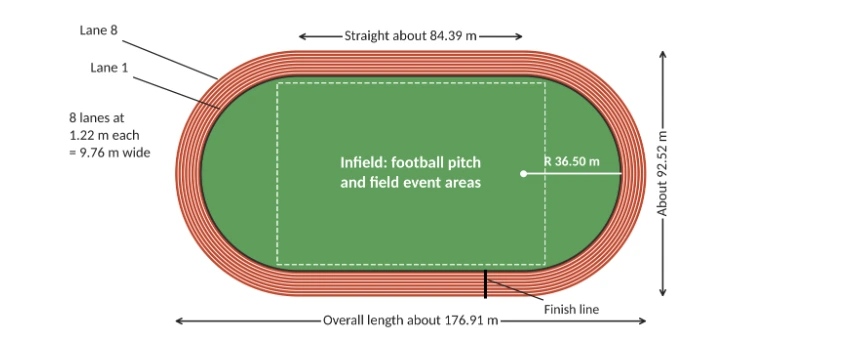
Standard 400m Track Specifications
| Specification | Standard 400m Track |
|---|---|
| Lanes | 8 (9 possible) |
| Lane width | 1.22 m |
| Inner kerb radius | 36.50 m |
| Lane 1 measurement line | 36.80 m radius |
| Straights | About 84.39 m |
| Overall size, 8 lanes | About 176.91 × 92.52 m |
| Land for the oval | About 16,400 sq m (4 acres) |
| Cross slope | 1:100 (1%) maximum, towards the inside |
| Running direction slope | 1:1000 maximum |
World Athletics Certification (Class 1 and Class 2)
- World Athletics certifies surface products and facilities. Facilities are rated Class 1 or Class 2. A surface alone is never “Class 1”.
- A certified facility needs a certified surface plus compliant geometry, field event areas and warm up space.
- Facility certification lasts up to 5 years and product certification up to 4 years. Both can be renewed.
- Higher level meets, such as Continental Tour Bronze events, need at least a Class 2 facility.
Indian Guidelines (AFI and SAI Norms)
The Athletics Federation of India follows World Athletics geometry. Sports Authority of India tenders commonly ask for a Class I, full PUR, full EPDM surface or 13.5 mm prefabricated rolls. For schools, CBSE affiliation bye laws (clause 8.7) require ground for a 200m track. Check the latest circular or tender before you freeze a design.
200m and 6 Lane Tracks for Schools and Practice
- 200m track: meets the CBSE minimum and suits daily PE and school meets.
- 6 lane 400m track: a narrower footprint for club and college training.
- Straight sprint lane: a 100m lane with a run out zone suits campuses with no room for an oval.
PROFESSIONAL ATHLETIC TRACK SURFACE TYPES
Synthetic track construction offers four main systems. Each trades cost, speed and seamlessness differently.
| Surface | How It Is Built | Best For | Watch Out For |
|---|---|---|---|
| Prefabricated rolls | Factory-made rubber rolls glued to the base | Stadiums, fast timelines | Joints; limited partial refurbishment options; 4–6 weeks to install |
| Spray coat | SBR rubber base with a PU spray finish | Schools, universities, grassroots | Thinner wearing course |
| Sandwich | Rubber base, PU layer, EPDM granules on top | Colleges, clubs, academies | Requires skilled applicators |
| Full PUR (full pour) | About 13 mm of PU and EPDM poured on site | Competition and certified tracks | Highest cost; seamless finish |
How to choose: match the system to your competition level, budget and local weather. Then ask for certification papers and a sample.
STEP BY STEP ATHLETIC TRACK CONSTRUCTION PROCESS
Running track construction follows nine stages, always in this order. Most early failures start in stages 2 to 6, long before the surface goes down.
1. Site Survey and Soil Testing
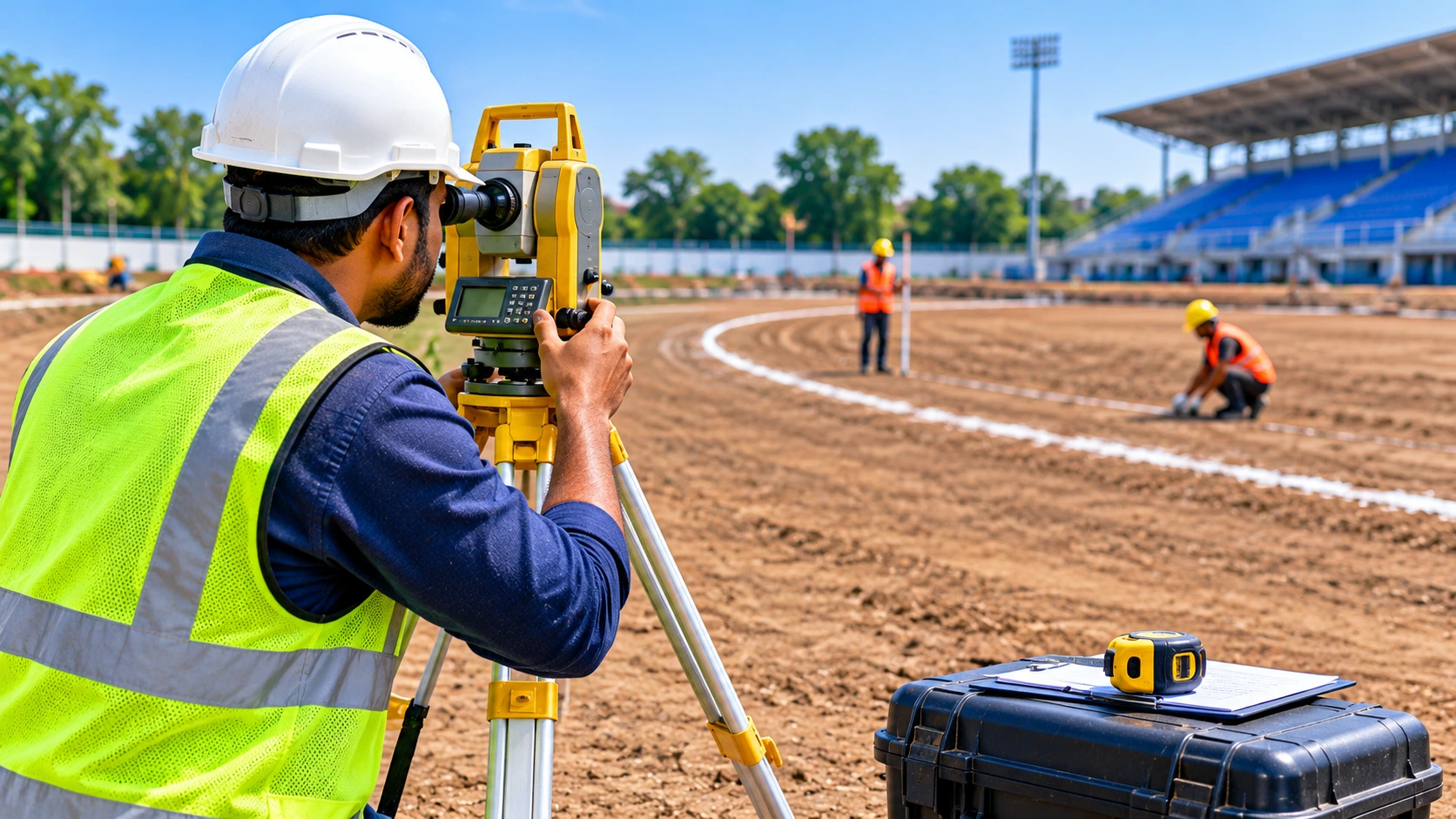
A topographic survey, soil tests and groundwater checks fix the track levels and show how much sub grade treatment you need.
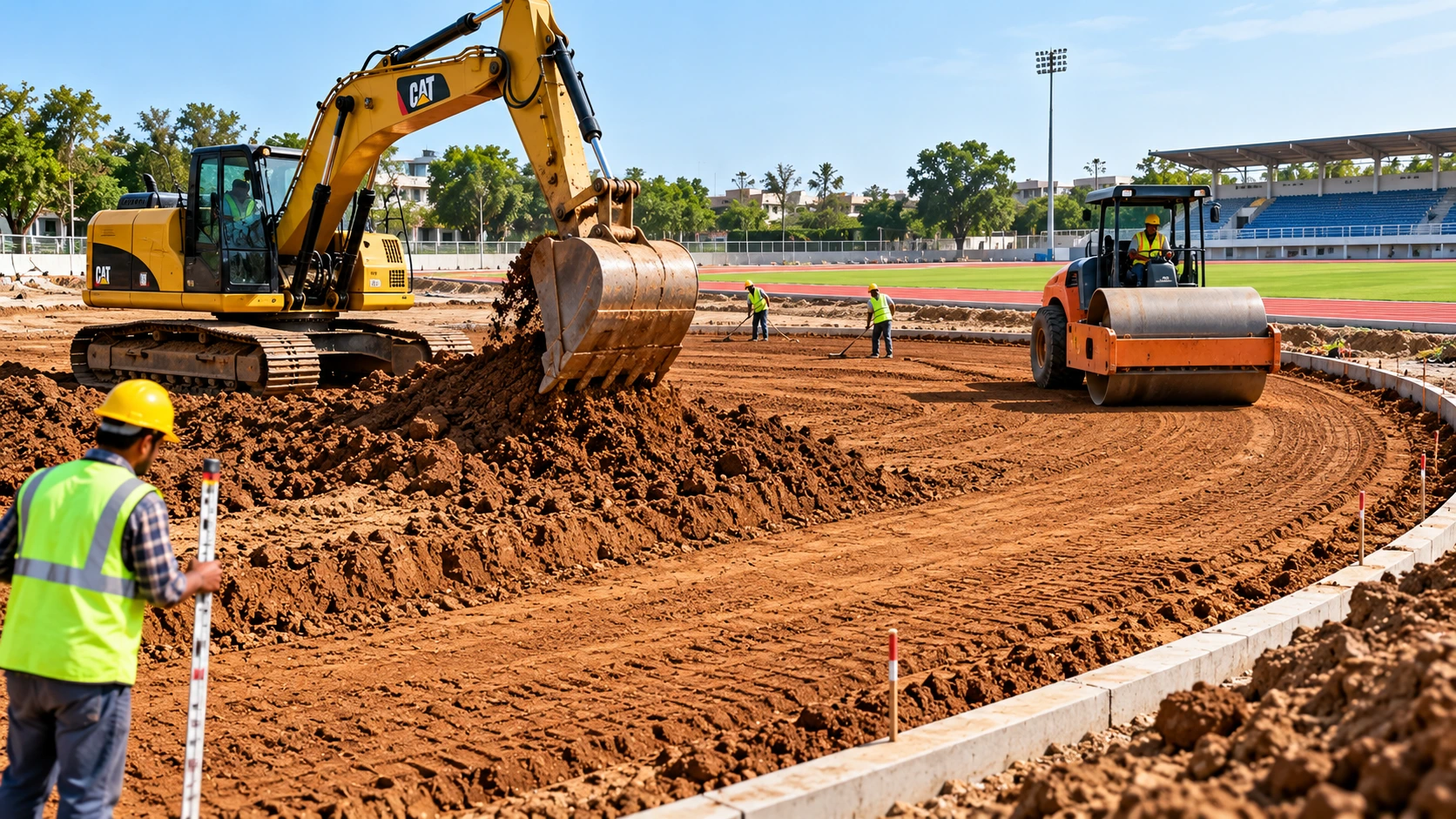
2. Excavation and Sub Grade Preparation
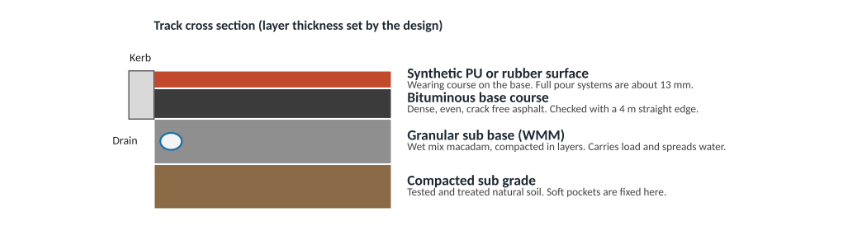
Excavate to design levels, remove organic soil and compact evenly. Soft pockets are treated now, not after paving.
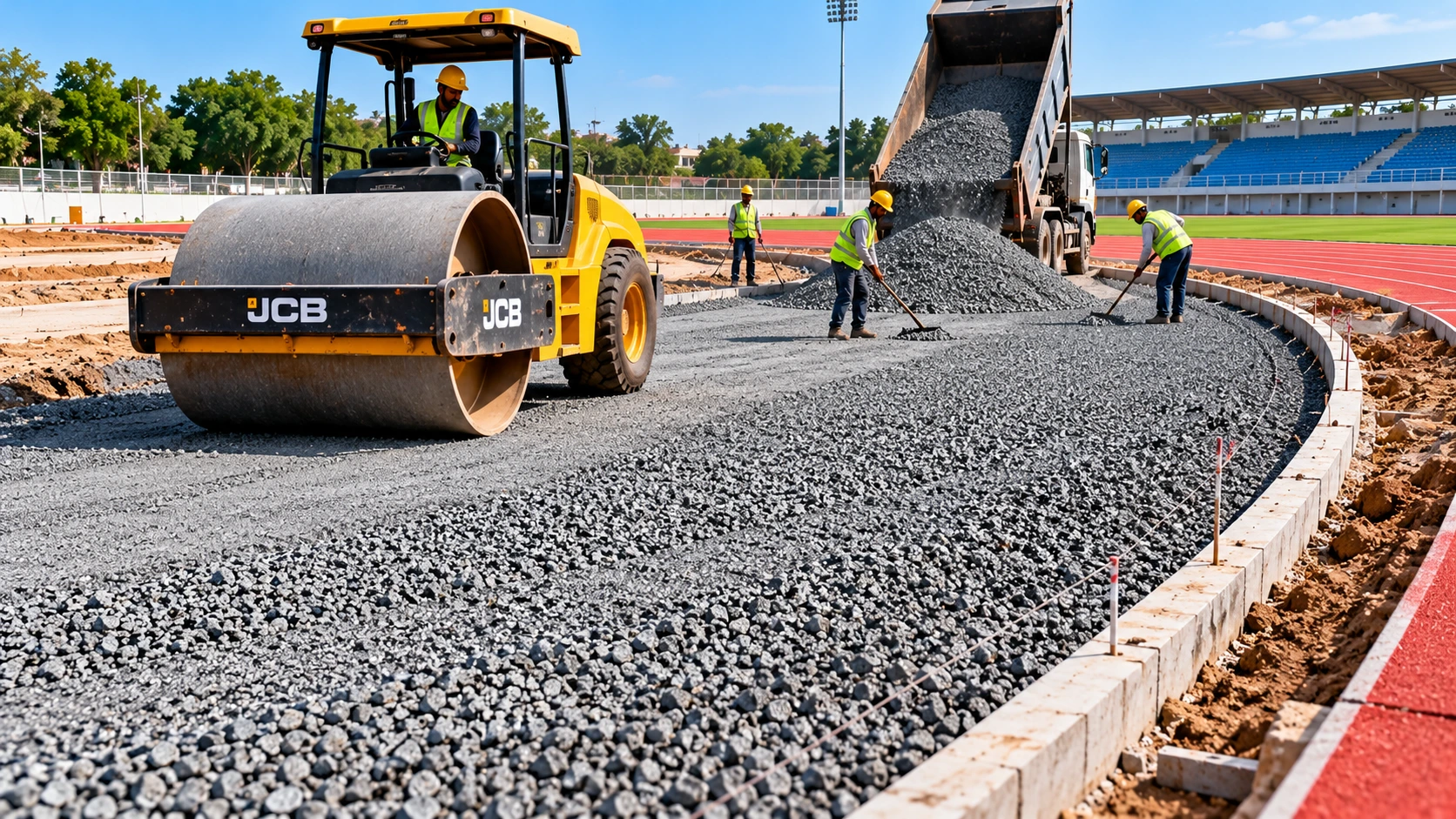
3. Granular Sub Base (WMM)
Wet mix macadam is laid and compacted in layers to carry load and spread water. Levels are checked after every layer.
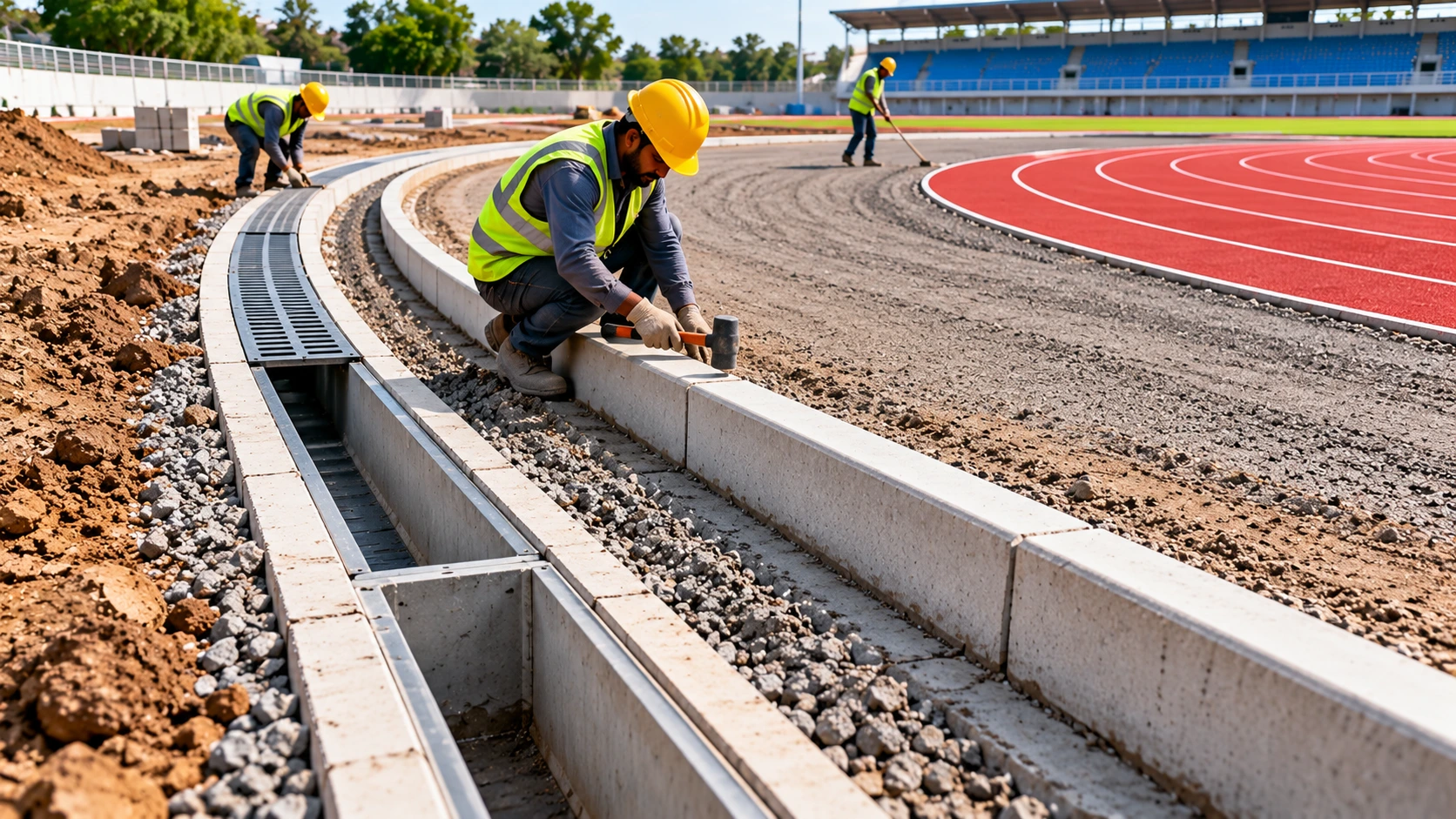
4. Drainage and Kerb
Perimeter drains and outlets keep water off the base. The kerb marks the inner edge and holds the geometry.
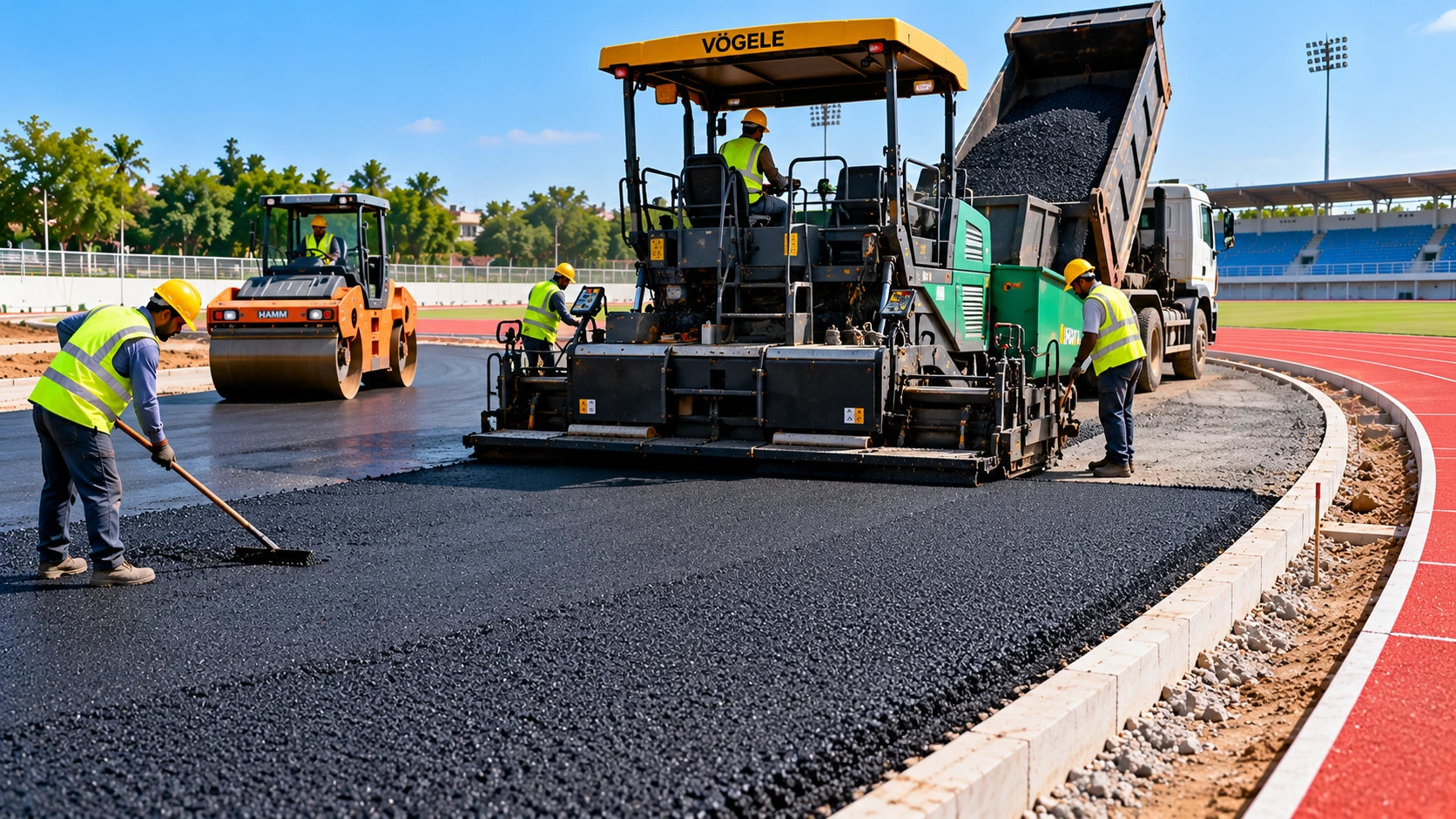
5. Bituminous Base Course
A dense, even, crack free asphalt layer forms the platform. Evenness is checked with a 4 m straight edge.
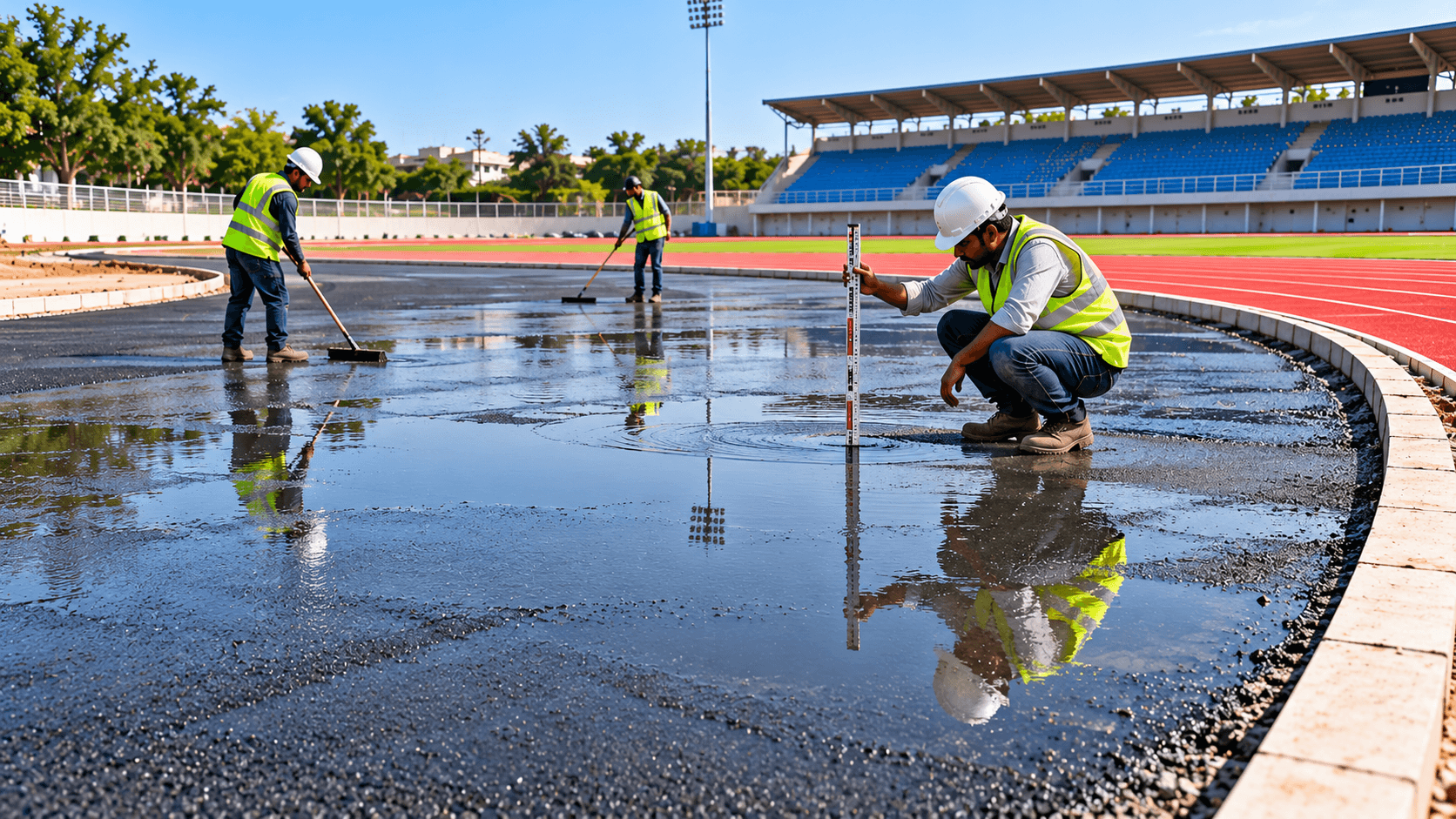
6. Base Curing and Water Puddle Test
The base cures fully, then is flooded. Water that pools shows low spots to correct before the surface goes on.
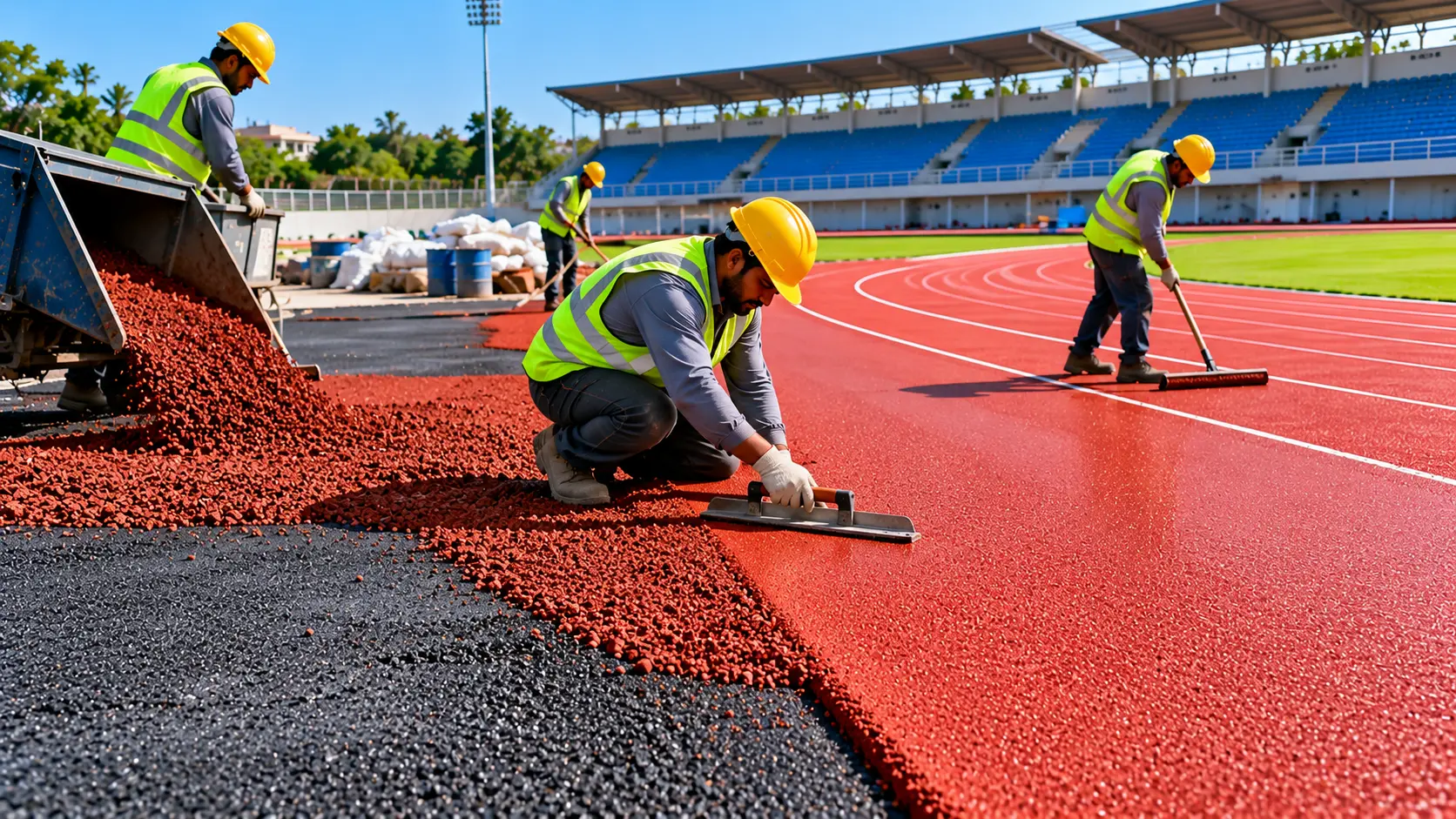
7. Synthetic PU or Rubber Surface
Binder, rubber granules and EPDM are applied by system, within the weather window the maker specifies. Thickness is tested at set points.
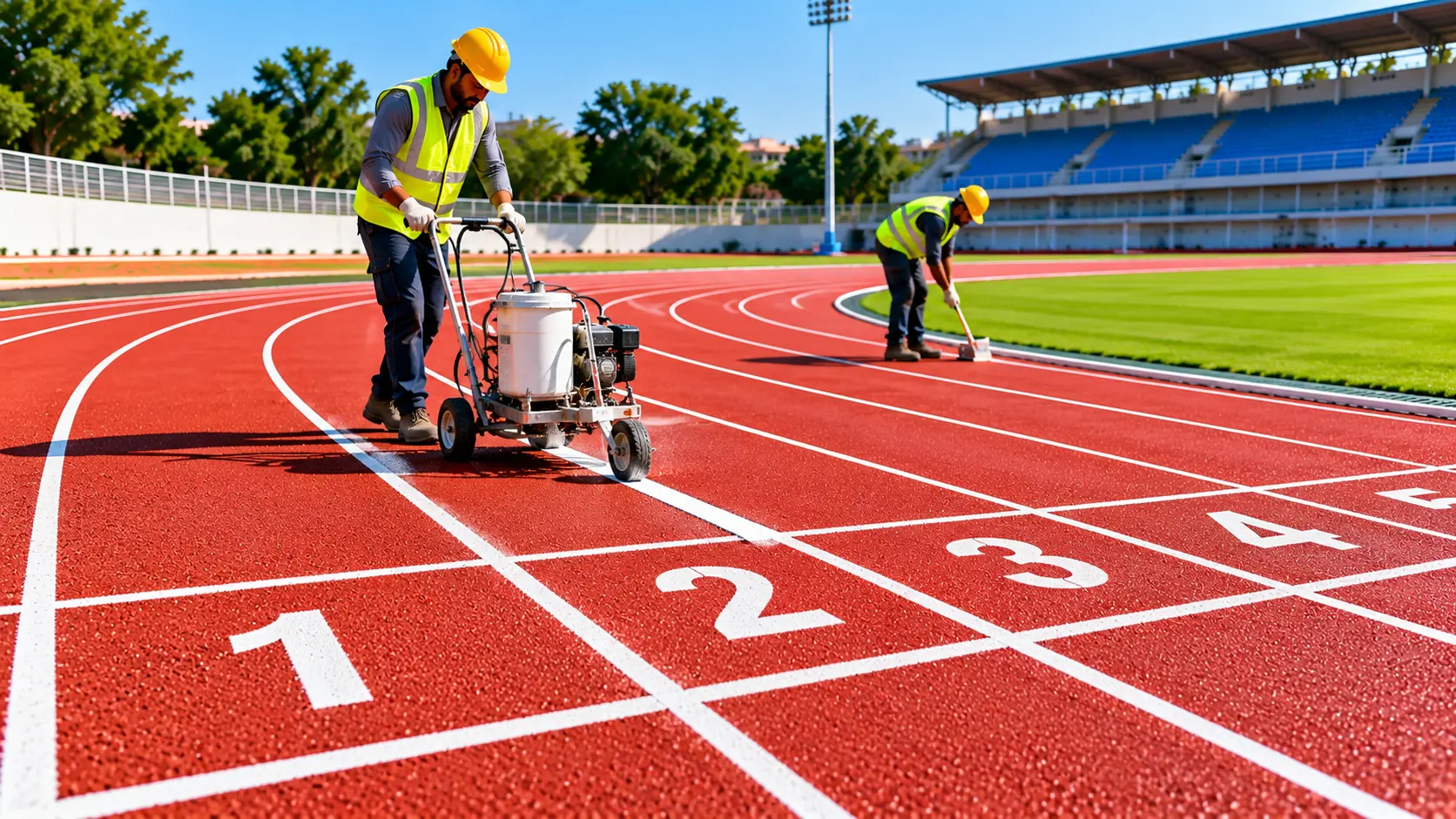
8. Line Marking to World Athletics Specification
Surveyors set out lane lines, start and finish lines, hurdle and relay marks. Paint follows the specified widths and colours.
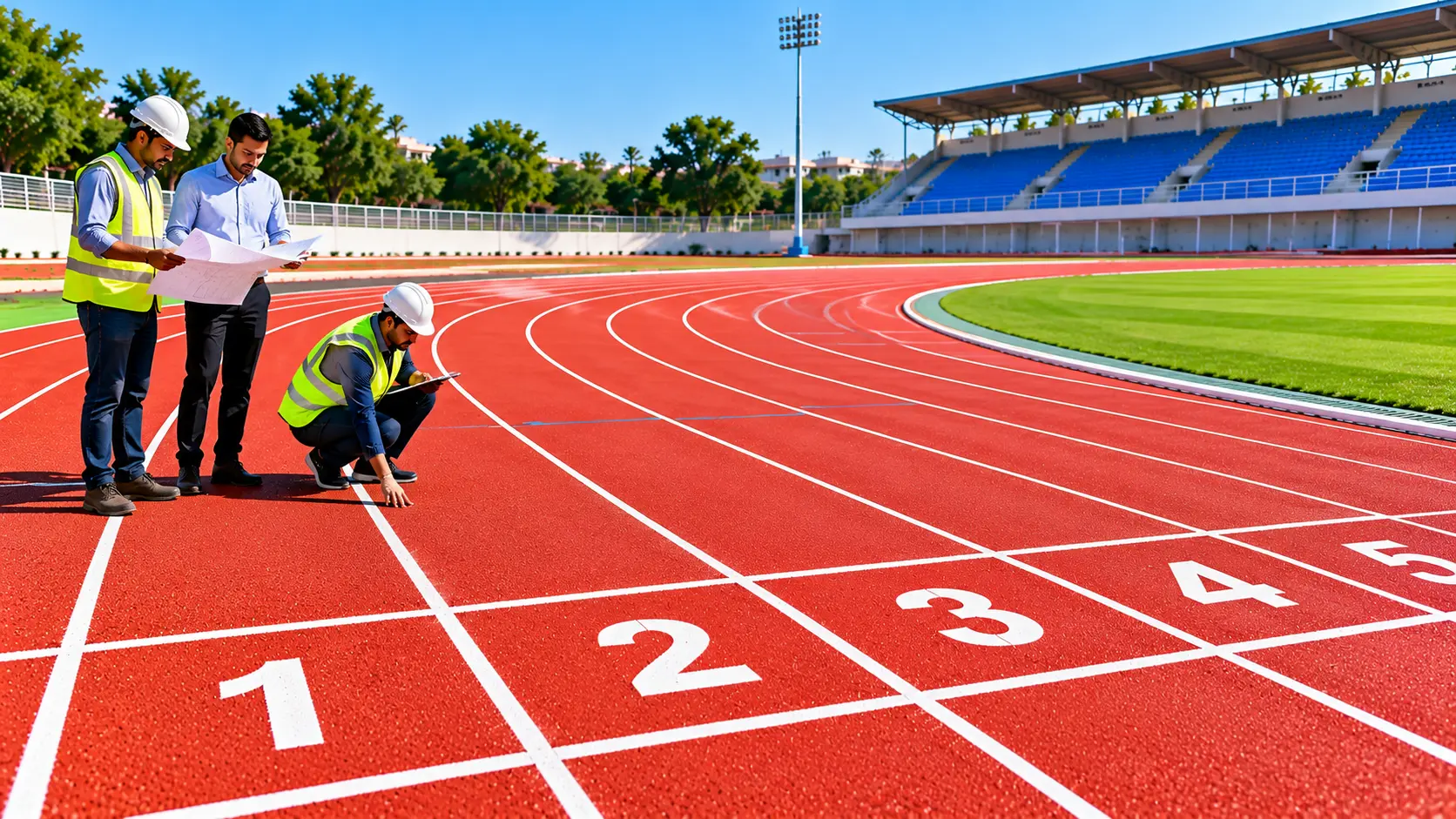
9. Final Inspection and Handover
Levels, thickness, slope, markings and drainage are checked against drawings. You receive care guidelines and warranty papers.
ATHLETIC TRACK CONSTRUCTION COST IN INDIA
No two tracks cost the same. These factors move your budget:
- Surface system, from spray coat to full pour
- Track size, lane count and certification level
- Site condition, earthwork and soil treatment
- Drainage, kerb, jump pits and fencing
- Lighting, field event areas and handover testing
Surface Only, 8-Lane 400m Track
Estimated surface area: approximately 45,000 sq ft.
| System | Rate per sq ft | Surface Cost |
|---|---|---|
| Spray coat | Rs 70 to 110 | Rs 32 to 50 lakh |
| Sandwich | Rs 110 to 160 | Rs 50 to 72 lakh |
| Full PU | Rs 140 to 200 | Rs 63 to 90 lakh |
Full Facility Cost Benchmarks from Public Sanctions
| Project | Scope | Cost |
|---|---|---|
| Kota, Srinathpuram (2022) | 400m, 8 lanes, full PUR | About Rs 7 crore |
| Vijayawada, IGMC (2026) | 400m, 8 lanes, 25m floodlights | Rs 9.50 crore |
| JNTUK, Kakinada | 400m, 8 lanes | Rs 13.55 crore |
WHO NEEDS AN ATHLETIC TRACK?
- Schools: CBSE affiliation expects a 200m track or equivalent ground.
- Colleges and universities: athletics teams, inter college meets and fitness programmes.
- Sports academies: sprint, middle distance and conditioning training.
- City sports complexes: Khelo India style district facilities open to the public.
- Townships and corporate campuses: synthetic jogging tracks that residents use daily.
Questions to put to any running track builder
- Which World Athletics certified surface will you use, and can I see the certificate?
- What base and drainage design do you propose for our soil?
- Will your own crew do the work, or subcontractors?
- What does the warranty cover, and for how long?
- Can I visit a track you have completed?
WHY CHOOSE THE SPORTS HABITAT FOR ATHLETIC TRACK CONSTRUCTION
The Sports Habitat is a turnkey sports infrastructure company in Bengaluru with 44+ projects and over 2.2 million sq ft delivered.
- Track experience: a 100m IAAF approved artificial turf sprint lane with a 20m deceleration zone at Ekya School, Byrathi .
- Planning first: CAD layouts, 3D visualisation, laser levelling and sub base testing before work starts.
- One team: survey, civil work, surfacing and handover under one turnkey contract .
- After handover: 12 months of complimentary maintenance, with optional AMC through our maintenance service .
Planning a full 400m facility? We assess your site and source certified surface systems for your target level. Read our checklist for choosing a sports infrastructure company before you shortlist anyone.
A good track is built from the ground up: the right base, honest drainage, a surface matched to your level and markings that follow the rulebook. Decide your target level first, because it drives every number in this guide. Then choose a team that can explain each of the nine stages without hurry.
FAQ - Frequently Asked Questions
Recent public sanctions put a 400m, 8 lane facility at roughly Rs 7 to 13.5 crore, depending on scope. A school track costs far less.
A compacted sub base and bituminous base, topped with rubber granules bound by polyurethane, often with an EPDM wearing course.
Surface systems are quoted at roughly Rs 70 to 200 per sq ft, before base, drainage and kerb work.
Budget for the whole build, not only the surface. A 200m school track is a far smaller commitment than a 400m facility.
Judge firms on finished track projects, certified surfaces, in house civil capability and maintenance support. Ask to visit a completed site.
It depends on length, lanes, base condition and system. A short sprint lane costs a fraction of a full oval. Request a site quote.
The surface alone runs about Rs 32 to 90 lakh for 8 lanes. The full facility reaches crores once base work and lights are added.
Planning an athletic track construction?
Share your site, lane count and target level, and our team will send a costed plan.