
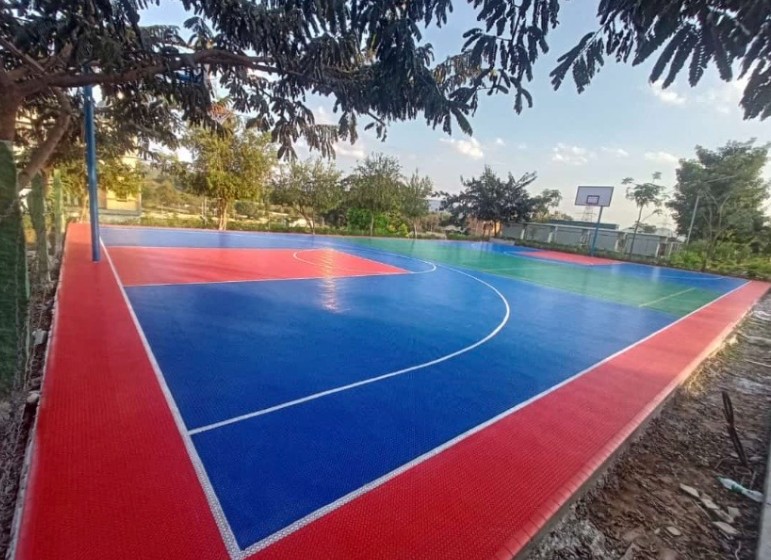
A corporate campus in Bangalore. Gleaming synthetic turf, freshly painted lines, a football court that was the envy of every weekend warrior in the complex.
Three years later, the seams are peeling. Water pools after every monsoon shower. A player slips and scrapes his knee on a patch of delaminated EPDM rubber. The facility manager shakes his head, not in disbelief, but in regret.
“We saw the signs,” he admits. “We just didn’t know what they meant.”
This story plays out across sports facilities every single year — in schools, corporate campuses, and multi-use athletic centres — because sports court maintenance is one of those things that’s easy to defer until it’s impossibly expensive to fix. We’ve moved from a culture that valued resilience to one that quietly accepts planned obsolescence where visible failure becomes the trigger for action. The average cost of a full court resurfacing runs significantly higher than a proactive maintenance contract, yet most facility owners only call in the experts after visible failure has already set in.
That changes today. From the knowledge of experts who work on these courts every single day, here are the five warning signs your sports court is sending you, and what to do about each of them before you’re staring down a six-figure repair bill.
01. Reflective Cracking on Acrylic Courts
You’ve seen them: those thin, spidery lines running across your acrylic court surface that seem to appear out of nowhere. They’re a distress call.
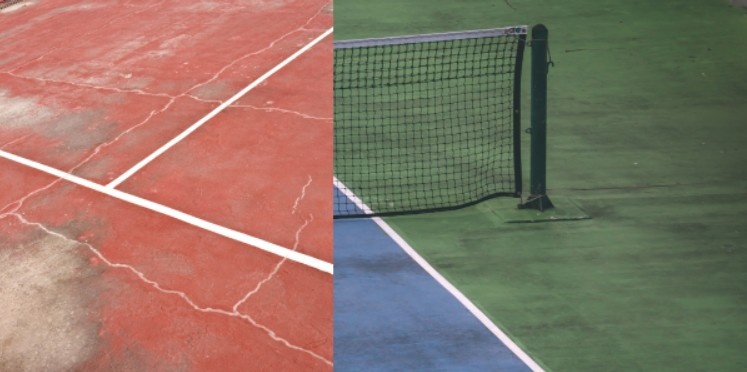
Reflective cracking happens when the PCC (Portland Cement Concrete) base beneath the acrylic layer develops shrinkage cracks or poor expansion joints. The stress migrates upward through the surface, manifesting as those tell-tale fissures you can trace with your finger, that everyone has seen but never knows how to tackle. At first, they look minor — a millimeter wide, maybe less. But water infiltrates. UV breaks down the acrylic coating at the edges. Freeze-thaw (temperature) cycles — even mild ones — widen the gap. Within a season or two, what was a hairline crack becomes a channel through the entire surface system.
Reflective cracking is the court telling you the foundation needs attention, not the surface.
The fix at an early stage means targeted crack filling and acrylic resurfacing on the affected zone. If you are too late, that entails full-surface resurfacing at three to five times the cost.
Instead, a Technical Audit* — involving base and slope inspection, drainage assessment, and surface wear mapping — can identify exactly how far the damage has progressed and whether you’re still in the cost-effective intervention window.
02. Water Stagnation and Persistent Puddling
After a heavy rain, your court should be playable within 15 to 20 minutes. If it isn’t — if you’re staring at standing water an hour after the clouds clear — you have a drainage problem, and it is not going to fix itself.
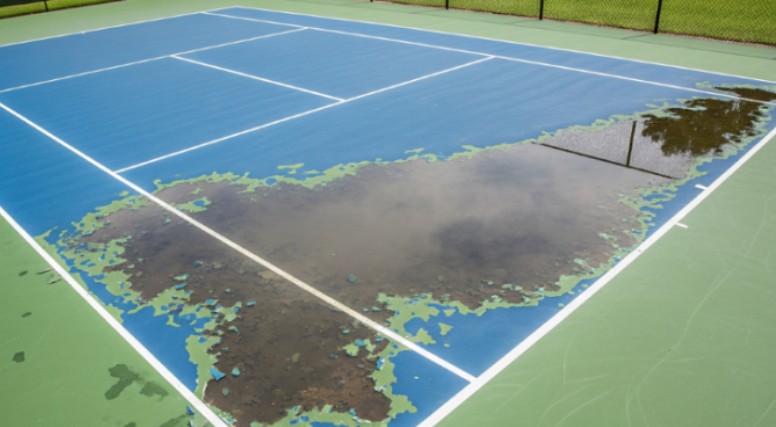
Water stagnation is caused by one or more of three things: incorrect surface slope (anything below 1% will not drain adequately), blocked or undersized drain channels, or base settlement that has created low points where water collects. On football turfs with advanced French draining systems, the industry benchmark is readiness to play within 15-20 minutes of even heavy rainfall. Courts that consistently miss this benchmark are silently accumulating damage with every wet season.
The consequences follow: Surface delamination, where the acrylic or turf layer loses adhesion to the base. Safety hazards — wet synthetic surfaces have dramatically reduced traction coefficients, increasing the risk of falls and injuries. And over time, base settlement accelerates as water undermines structural integrity.
If your facility doesn’t know its surface drainage rate, a drainage assessment as part of a Technical Audit is the first step. Solutions range from drain cleaning and slope correction to base rectification, but the window for minor intervention closes fast.
03. Turf Seam Separation
On synthetic turf courts, the seams — those joins between adjacent rolls of turf — are the system’s most vulnerable points. They’re also the first to fail.
Seam separation happens when adhesive degrades over time or when high-use stress zones (think the goal mouth on a football pitch, or the baseline of a tennis court) subject joins to constant directional loading. A separated seam might be just a few centimetres wide, easy to miss during a casual walkthrough. But to a sprinting player, it’s a trip hazard. And once the seam opens, moisture penetration accelerates adhesive failure on adjacent sections, creating a cascade effect.
DLS Turf Courts | Seams are the make-or-break of any turf project. The S-Wavy Seam Method is a pro installer’s trick for smooth, invisible joins that last…. | Instagram
Seam strength review is a standard component of a proper Technical Audit and can determine whether a seam requires spot repair or full re-seaming. Scheduled inspections under an Annual Maintenance Contract (AMC) catch seam issues before they become trip hazards or liability exposures for your facility.
04. Infill Compaction on Football Turf
This one is invisible to the untrained eye, and that’s what makes it dangerous.
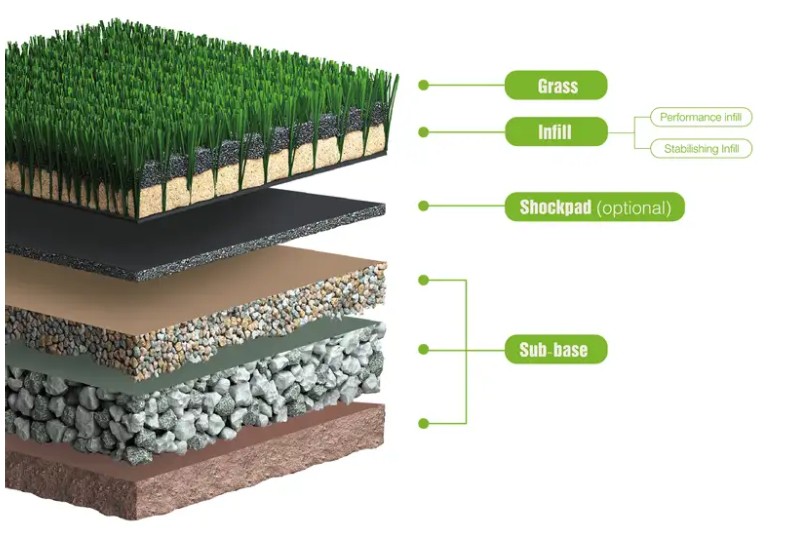
Synthetic football turf relies on rubber or sand infill granules distributed between the turf fibres to provide cushioning, traction, and the biomechanical properties that protect players’ joints. Over time, heavy usage compacts this infill. Granules bind together, the pile loses its resilience, and what was once a surface with appropriate shock absorption becomes essentially a firm substrate with a thin green carpet on top.
The result?
Increased injury risk. Joint impact forces that were designed to be absorbed by the infill are instead transmitted to players’ ankles and knees. Studies in sports science literature consistently show that inadequately maintained infill is a contributing factor to non-contact lower limb injuries in artificial turf sports.
Regular infill top-up and grooming — services included in a well-structured AMC — keep the surface performing to specification. Shock absorption checks during a Technical Audit by one of The Sports Habitat experts, can quantify exactly how far the surface has drifted from the original performance standard, and whether top-up or full infill replacement is required.
05. EPDM Granule Loosening, Edge Curling, or Base Settlement
The fifth warning sign is actually three related symptoms that frequently appear together on aging courts, particularly those with EPDM (Ethylene Propylene Diene Monomer) rubber surfaces or acrylic systems approaching the end of their design life.
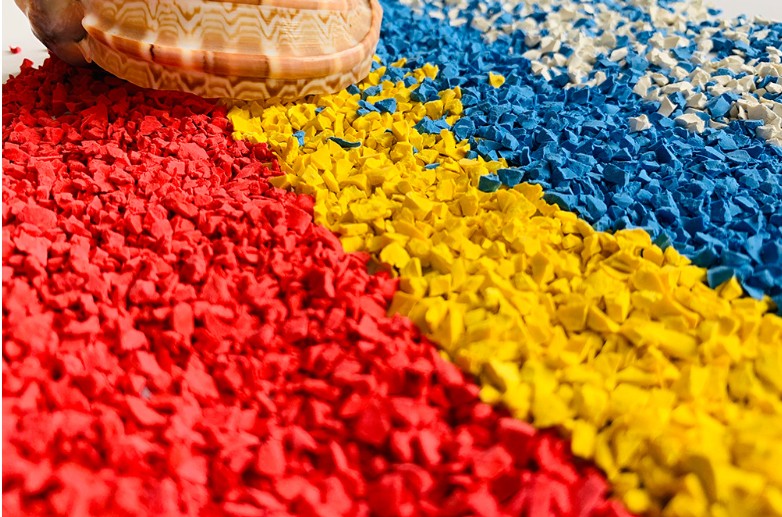
EPDM granule loosening happens when the polyurethane binder holding rubber granules together degrades under UV exposure. You’ll notice granules collecting at court edges or being tracked off the playing surface. Without the binder matrix, the surface becomes brittle and loses its characteristic shock absorption — a particular concern on running tracks and multi-use courts where EPDM is prized for its impact properties.
Edge curling and delamination is a moisture problem at its core. When the membrane’s edges lose adhesion to the substrate — typically from moisture ingress from the sub-base or perimeter — the surface begins to lift and curl. Left unaddressed, this progresses to system-wide failure as the delamination migrates inward.
Base settlement is the most serious of the three. Inadequate original compaction (the industry standard requires a minimum of 95% MDD — Maximum Dry Density) allows the sub-base to compress under repeated loading. The result is uneven play surfaces and structural cracking that propagates upward through every layer of the system.
The sports court that last 20+ years aren't the most expensive ; they're the most consistently maintained.
So What Should You Actually Do?
The good news is that none of these failure modes appear overnight. They develop over months and years, and the intervention window — where a targeted repair costs a fraction of a full replacement — is substantial if you know what to look for.
There are three service models worth understanding:
An Annual Maintenance Contract (AMC) is designed for facilities in continuous use; schools, corporate campuses, sports complexes. It delivers scheduled inspections, turf grooming, infill top-ups, seam checks, crack monitoring, line marking touch-ups, and drainage cleaning. It’s preventive care that extends the lifecycle of your surface and avoids the accumulation of deferred maintenance that makes eventual repairs so expensive.
Facilities under structured maintenance consistently outlast those that rely on reactive repairs.
A Technical Audit is the right starting point if your facility is approaching a resurfacing decision or if you’re seeing early warning signs and aren’t sure how serious they are. It provides a structured assessment: base and slope inspection, drainage evaluation, surface wear mapping, adhesion testing, seam strength review, and shock absorption measurement. It gives you data (not guesswork) on the current condition of your asset and what it needs.
If your court is approaching a resurfacing decision or you’re noticing early warning signs but aren’t sure how serious they are, book a technical audit to get started.
A One-Time Corrective Fix addresses courts that are already showing visible damage. Crack filling, acrylic resurfacing, turf seam repair, EPDM patchwork, infill correction, puddle rectification; these are the targeted interventions that restore usability before a court reaches the point of no return.
Request a corrective fix assessment today.
The Cost of Waiting
Here’s the uncomfortable reality that every facility manager who has ever managed a sports court knows but rarely says out loud: the cost of fixing a court after failure is three to five times the cost of maintaining it before failure. And the non-financial costs — player injuries, liability exposure, facility downtime, reputational impact — don’t appear on any maintenance budget line.
The five signs above are your early warning system.
- Reflective cracking shows your base is screaming for help.
- Puddling causes your drainage to be compromised.
- Seam gaps indicate your joins are failing.
- Hard turf ensures your infill is depleted.
- Loose granules and curling edges mean your surface system is aging out.
Each of these signs, caught early, is a manageable maintenance task. Caught late, it’s a capital project.
The courts that serve their facilities well for fifteen to twenty years aren’t necessarily the most expensive courts. They’re the most consistently looked after. That’s not a coincidence. It’s the oldest lesson in facilities management, applied to six hundred square metres of synthetic turf or acrylic.
Pay attention to what your court is telling you…before it’s too late.
Is Your Sports Court Showing Signs of Wear?
Don’t wait until minor issues become costly repairs. Get professional sports court maintenance to keep your court safe, durable, and ready for play. Contact Us today for expert court maintenance and repair services.
Frequently Asked Questions
How often does a sports court need professional maintenance?
Most sports courts need a professional inspection at least once a year, with more frequent care for high-use facilities. An Annual Maintenance Contract (AMC) typically covers scheduled turf grooming, infill top-ups, seam checks, and drainage cleaning to catch issues before they escalate — rather than waiting for visible damage.
What are the signs a sports court needs maintenance?
The most common warning signs include reflective cracking on acrylic surfaces, water pooling or slow drainage after rain, turf seam separation, compacted infill on football turf, and loose EPDM granules or curling edges. Each of these indicates an underlying issue — base, drainage, or adhesive failure — that gets more expensive to fix the longer it’s ignored.
How long does a sports court surface last with proper maintenance?
With regular professional maintenance, acrylic courts typically last 5–8 years before resurfacing, while synthetic turf systems can perform well for 8–10+ years. Courts without structured maintenance often need major repair or replacement significantly sooner, since small issues like cracking and seam wear compound over time.
How much does sports court maintenance cost compared to repair or resurfacing?
Preventive maintenance costs a fraction of reactive repair — industry experience shows full resurfacing after visible failure typically runs three to five times higher than the cost of an ongoing maintenance contract. Catching issues like reflective cracking or drainage failure early keeps repairs targeted and affordable.
Can I maintain a sports court myself, or do I need a professional?
Basic upkeep like debris removal and light cleaning can be done in-house, but structural issues — base cracking, drainage failure, seam separation, infill compaction — require professional assessment. A trained team can identify problems (like inadequate sub-base compaction or slope defects) that aren’t visible during a routine walkthrough but directly affect player safety.
What is a technical audit for a sports court?
A technical audit is a structured professional assessment that includes base and slope inspection, drainage evaluation, surface wear mapping, adhesion testing, seam strength review, and shock absorption measurement. It’s the recommended first step if a court is showing early warning signs or approaching a resurfacing decision.
Why does water pooling on a sports court matter?
A well-drained court should clear standing water within 15–20 minutes of rainfall. Persistent puddling signals incorrect surface slope, blocked drainage, or base settlement — left unaddressed, it accelerates surface delamination and creates slip hazards from reduced traction on wet synthetic surfaces.
Does synthetic turf need maintenance if it's marketed as "low-maintenance"?
Yes — synthetic turf is lower-maintenance than natural grass, but not maintenance-free. Infill compaction, seam wear, and drainage performance all degrade with use and require periodic inspection and grooming to keep the surface performing to its original safety and playability standards.
What is the cost of sports court maintenance in India?
Sports court maintenance cost in India varies based on surface type (acrylic, synthetic turf, EPDM), court size, current condition, and whether it’s under a one-time corrective fix or an Annual Maintenance Contract (AMC). AMC plans are typically priced per year and cover scheduled inspections, turf grooming, infill top-ups, and drainage checks — costing significantly less than reactive repairs, which can run three to five times higher once a surface fails. For an accurate quote based on your facility’s surface type and size, get in touch with The Sports Habitat for a tailored maintenance estimate.