
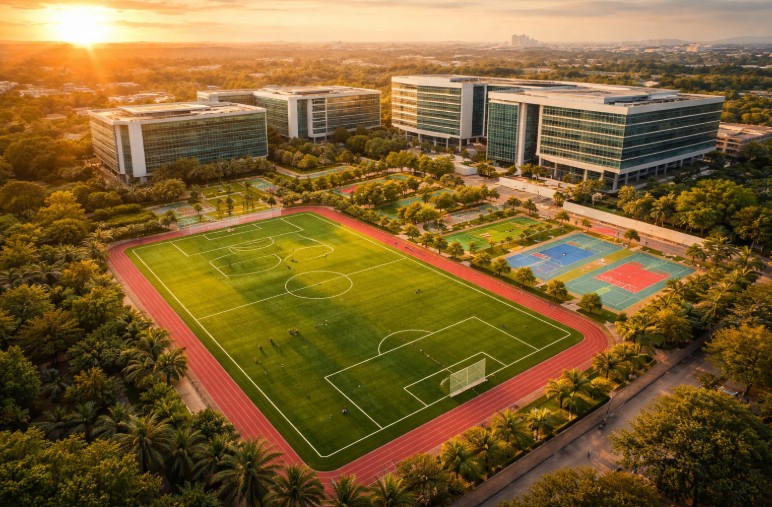
India’s most forward-thinking companies aren’t mandating the return to office but also making it irresistible. Here’s how world-class on-campus sports infrastructure is becoming the defining differentiator in the talent war.
The Mandate Backlash is Real And It's a Design Problem
India’s corporate landscape is in the middle of a quiet negotiation. Return-to-office policies, once issued as directives, are now being rethought as offers. The companies seeing the highest voluntary in-office attendance aren’t the ones with the strictest policies, they’re the ones with the most compelling campuses.
When employees weigh a commute against a productivity-optimised home setup, the calculus is simple: the office has to earn it. That means beyond the open-plan desks and the third-wave coffee machine, there needs to be something genuinely worth showing up for. Increasingly, that something is sport.
A well-designed sports facility on campus doesn’t just offer recreation. It creates ritual. It builds social bonds that a Slack channel never can. It signals to an employee — before they even lace up — that the organisation cares about their whole life, not just their billable hours.
73%
of employees cite wellness amenities as a top factor in accepting a new role
2.4x
higher voluntary RTO rate at campuses with active sports infrastructure
38%
reduction in attrition reported by Indian corporates with structured sports leagues
Three Kinds of Corporate Clients, Three Very Different Needs
The organisations investing in campus sports infrastructure today aren’t a monolith. When The Sports Habitat works with corporate clients, we encounter three distinct segments, each with a specific value equation around sports.
01. Multi-Tenant Tech Parks & Developers
Sports infrastructure becomes a leasing lever — a visible, tangible differentiator that justifies premium rentals and retains anchor tenants over the long term.
02. Single-Occupier Corporate Campuses
HR and leadership teams invest in sport as a culture-building and talent-attraction programme, often tied to the company’s EVP and long-term retention strategy.
03. Premium Co-Working Spaces
Compact, visually striking sports zones serve a dual purpose: community-building for members and powerful brand positioning for the space itself.
Each of these clients arrives with different constraints: footprint, budget, expected usage intensity, and the sophistication of the stakeholder making the decision. But across all three, the underlying principle is the same: sport creates stickiness that no wellness stipend or free lunch programme can replicate.
The ITC Benchmark: When a Fortune 500 Company Gets It Right
ITC Limited, one of India’s most admired and diversified conglomerates and a consistent Fortune 500 India name, has long understood that the workplace is more than a functional space like a statement of intent. At their campuses, sports infrastructure isn’t an afterthought tacked onto a facilities budget. It is integrated into the architectural vision from the planning stage.
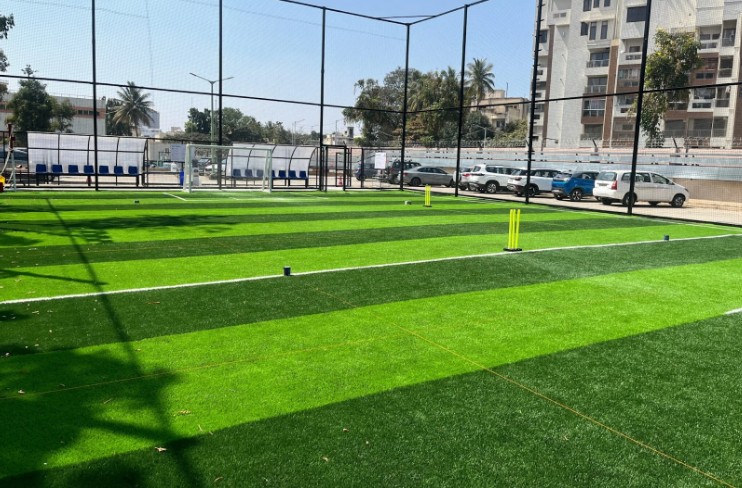
What sets the ITC approach apart is its dual commitment to professional quality and everyday accessibility. Their sports zones are built to a standard where an employee feels the difference from the moment they step onto the turf — the give underfoot, the precision of the court surface, the ergonomic design of the surrounding wellness zones. This isn’t infrastructure for a company newsletter photograph. It gets used daily, it hosts inter-department leagues, and it’s quietly become one of the most-cited reasons employees give when asked what they value about working there.
For corporate clients across India considering investment in campus sports, the ITC model offers a clear reference point: when the investment is made with genuine quality intent, the ROI arrives in the form of a campus people actively want to return to.
The Co-Working Opportunity: Compact Formats, Outsized Impact
Not every corporate client has a 10-acre campus. For premium co-working operators — the segment that has grown most rapidly in Indian metros over the past five years — the question isn’t whether to invest in sports, but how to do it intelligently within constrained square footage.
Here, the design language shifts. A multi-sport court in a 2,000 sq.ft. zone can serve the same psychological function as a full 5-a-side pitch on a corporate campus, provided the finish quality is right. Members of a premium co-working space are often solopreneurs, startup founders, or senior executives on secondment — they are acutely attuned to quality signals. A cushioned acrylic court with proper line-marking and a well-lit EPDM zone beside it communicates something that a bean bag corner and a ping-pong table simply cannot.
The strongest co-working operators are now using their sports infrastructure in their sales material, their social media, and their community programming. Morning yoga on the rooftop EPDM deck, a Friday five-a-side league, and a members’ badminton tournament are community architecture.
“This is, of course, to say that the office that earns the commute isn’t the one with the best meeting rooms. It’s the one where your colleagues become, in a meaningful way, the teammates you can count on. A great office environment, both physical and non-physical, helps facilitate that.” — The Sports Habitat Design Philosophy
What Gets Used: The High-Engagement Asset Stack
Experience across hundreds of corporate installations in India reveals a clear pattern: certain assets deliver disproportionate value in terms of daily engagement, operational simplicity, and employee satisfaction. These are the assets we build first — and the ones that define whether a campus sports programme succeeds or becomes an underutilised showpiece.
Highest ROI - 5-a-Side Football Turf
The single highest-engagement corporate sports asset in India. Supports daily informal play, formal inter-department leagues, and social bonding. Minimal technical upkeep beyond routine grooming.
Space-Efficient - Multi-Sport Acrylic Courts
Serves badminton, basketball, and futsal within a single footprint. Acrylic surfaces are durable, visually sharp, and require periodic maintenance only. Ideal where space is constrained.
Daily Engagement - Jogging & Running Tracks
Perimeter or loop tracks around campus green space create daily wellness rituals. Usage is passive, self-directed, and builds habitual morning and evening activity without any – programming required.
Low Maintenance - Outdoor Fitness Stations
Low-supervision, high-steady-engagement assets. Positioned along jogging routes or in campus green zones, they extend the workout without requiring staffing or scheduling infrastructure.
When the Campus Is a Flagship: Upgrading the Standard
Think of it; the Model-Modern Campus. Google’s Mountain View amphitheatre. Meta’s Menlo Park. All civilisations built around the working individual.
The Victorians had a utopian concept for it: the phalanstery, i.e., a self-contained cooperative community where work, living, recreation, and social life were architecturally fused. The idea was radical then. Today, it is the design philosophy of the world’s most talent-competitive organisations. When Amazon builds an indoor rainforest and Apple constructs a ring-shaped campus with a mile-long walking path, they are not making architectural statements for their own sake. They are building the infrastructure of a life that happens to include a job and doing so with enough intentionality that talented people will choose it over any alternative.
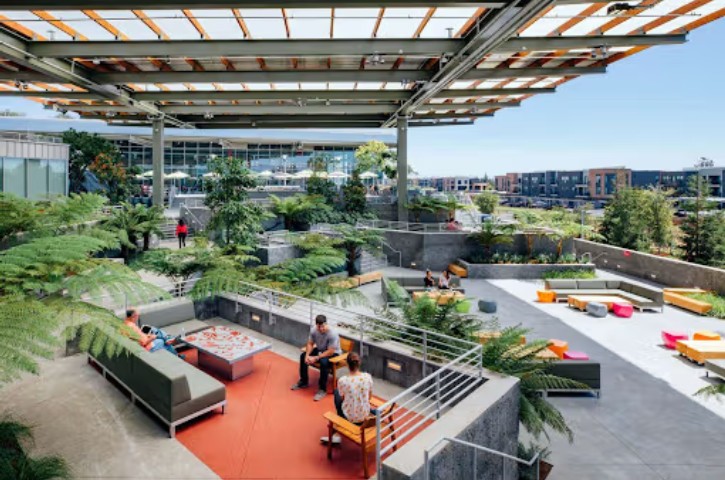
For organisations where the campus is a brand asset — where clients walk through, where leadership hosts talent, where the physical environment is expected to communicate corporate ambition — the specification changes significantly. The issue then becomes about a performance environment that happens to be on a corporate campus.
At this level, we move from functional infrastructure to engineered experience. Every surface choice carries consequences; for player safety, for the quality of play, and for the visual impression the space makes on everyone who sees it.
| Asset | Functional Tier | Flagship Tier |
|---|---|---|
| Football Turf | Standard synthetic turf, regular grooming | Shockpad-based professional turf - improved joint safety, superior ball roll, longer surface life |
| Court Surface | Acrylic hard court, standard finish | Cushioned acrylic or PU surface - reduced impact on joints, premium visual finish |
| Running Track | Compact loop or perimeter path | Full synthetic track loop with lane markings - supports structured training and community events |
| Wellness Zone | Open fitness stations | Designed EPDM wellness zones - visual impact, surface safety, programme-ready layout |
The shockpad-based turf specification, for instance, is more than a material upgrade. It changes the physics of every contact between player and surface, reducing cumulative joint stress that accumulates over months of daily play. For a corporate campus where employees are playing several times a week, this is meaningful. An injury from inferior surface design is a liability, and worse, an HR conversation.
Similarly, the move from standard acrylic to cushioned PU courts isn’t merely aesthetic. The surface absorbs the repetitive impacts that badminton and basketball generate, protecting knees and ankles over long-term use. They are the specification choices that reflect whether a campus genuinely cares about the people playing on it or is merely providing the optics of caring.
The Strategic Question Every Corporate Client Must Answer
Before specifying a single square foot of sports infrastructure, every corporate client must get honest about one question: what are we actually optimising for?
There are two fundamentally different answers, and they lead to two very different facility programmes:
Are you optimising for functional participation at scale or are you building a performance-led, brand-defining sports environment?
The Sports Habitat: Client Strategy Framework
The first path is entirely legitimate. If your campus has 2,000+ employees, you want sports infrastructure that gets used daily, accommodates leagues, and doesn’t create operational headaches. That means proven, high-engagement assets; 5-a-side turf, multi-sport courts, a jogging track, outdoor fitness stations; specified at a quality level that delivers durability and good play without requiring constant technical intervention. The maintenance footprint is predictable and manageable.
The second path is the right choice when the campus is a statement. When prospective hires walk the campus as part of their interview experience. When the organisation’s culture narrative includes the word “world-class.” When leadership wants the sports infrastructure to be the same quality as the office furniture on the executive floor. Here, the shockpad turf, the cushioned courts, the designed wellness zones, and the synthetic track loop aren’t optional upgrades but the baseline.
Neither answer is wrong. Both are served by The Sports Habitat. What we insist on is clarity, because the most common mistake in corporate sports infrastructure procurement is specification confusion: flagship aspirations delivered on a functional budget, resulting in a facility that does neither job particularly well.
Why Turnkey Delivery Changes Everything
The final variable in a successful corporate sports programme is often the least glamorous: execution. India has no shortage of organisations that have approved a sports facility budget, only to find themselves 18 months later with a half-completed construction site, a disagreement between the civil contractor and the surface vendor, and a project manager who is trying to manage both while also running something else.
The Sports Habitat’s turnkey model was built specifically to eliminate this failure mode. We are responsible for the full delivery chain — from compliance assessment and layout design, through material procurement and installation, to surface certification and handover. Our clients don’t need to manage multiple vendor relationships or navigate the complexity of sports surface standards. We hold the single thread that makes the whole project coherent.
Critically, our installations are designed around two non-negotiables: player safety and long-term experience quality. The infrastructure we build doesn’t just look right on an opening day photograph. It performs correctly three years later, after thousands of hours of use, because every specification decision was made with that durability horizon in mind.
Frequently Asked Questions
Do sports facilities actually improve return-to-office rates?
Yes — campuses with active sports infrastructure report significantly higher voluntary return-to-office attendance than campuses relying on mandates alone, because well-designed facilities create daily rituals and social bonds that a remote setup can’t replicate.
How much space is needed for a corporate sports facility?
Space requirements scale with format, not just ambition — a multi-sport court can be built in as little as 2,000 sq. ft. for premium co-working environments, while full campuses often combine football turf, acrylic courts, running tracks, and wellness zones across a larger footprint. Compact formats can deliver similar psychological impact to larger installations if the finish quality is right.
Do workplace fitness and sports amenities actually boost productivity?
Yes — on-site fitness facilities have been linked to as much as a 15% rise in employee productivity, alongside stronger social connections between colleagues and a greater sense of organizational support.
What's the difference between a corporate gym and a corporate sports facility?
A corporate gym typically offers equipment-based individual fitness, while a corporate sports facility (turf, courts, tracks) enables team-based, social, and league-style activity — the latter tends to drive stronger cultural and retention effects because it builds recurring social rituals, not just individual workouts.
Planning sports infrastructure for your corporate campus, tech park, or co-working space?
Create sports facilities that encourage employee participation, support workplace wellness, and make your corporate campus more engaging. Talk to The Sports Habitat about your project today.