
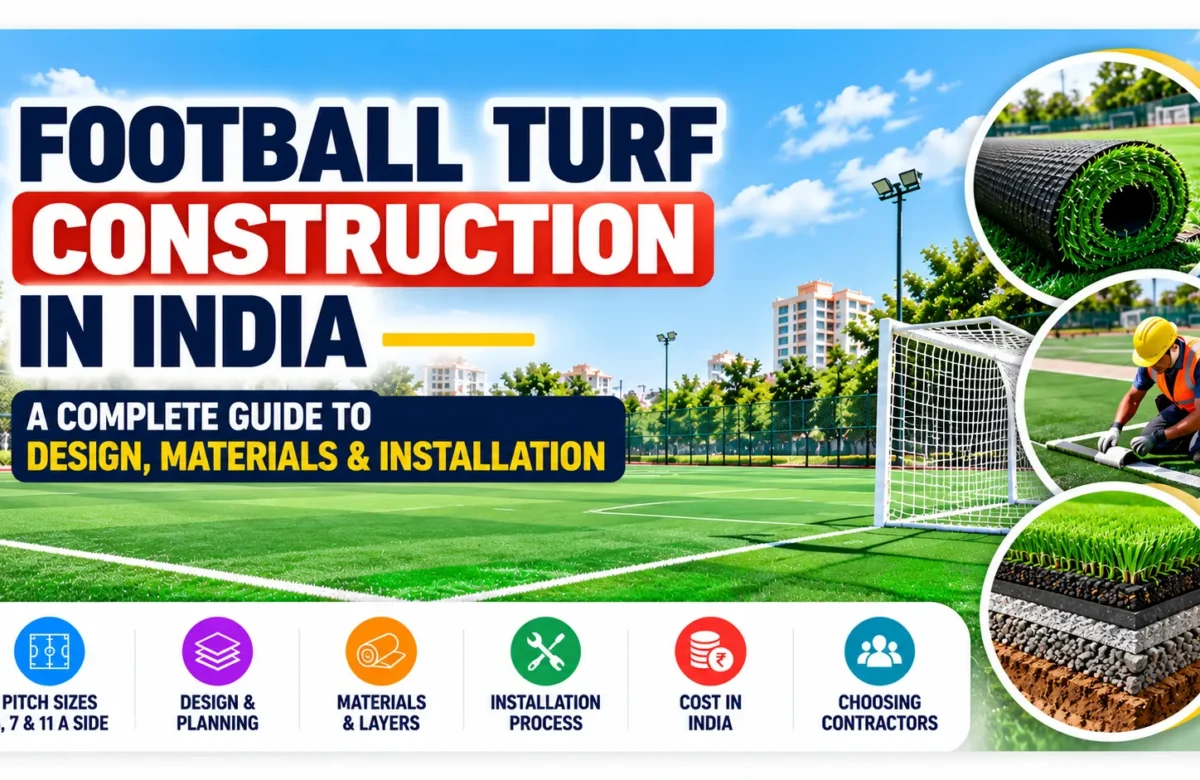
Football Turf Construction in India: A Complete Guide to Design, Materials & Installation
Football turf construction in India now reaches school grounds, rooftops, academies and pay and play arenas in every major city. Whether you plan a 5 a side box or a full 11 a side pitch, what lies under the grass decides how the field plays, drains and lasts. What is football turf construction? It is the process of building an artificial football pitch from the ground up: surveying the site, compacting the sub grade, laying drainage and a stone base, levelling, adding an optional shock pad, installing the turf carpet and filling it with infill. This guide covers pitch sizes, planning, layers, materials, the ten step installation, cost in India and how to choose football turf contractors. Use it to brief them with confidence.
KEY TAKEAWAYS
- Pitch sizes: 5 a side about 36.5 × 27.5 m, 7 a side about 55 × 36.5 m, 11 a side 105 × 68 m (FIFA recommended).
- Layers: sub grade, stone sub base, levelling layer, optional shock pad, turf carpet and infill.
- Pile height: 40 to 60 mm is typical, usually PE monofilament fibre.
- Base first: base and drainage decide long term performance. Slope about 0.5 to 1%.
- Timeline: surface installation takes about 4 to 6 weeks for a full pitch once the base is ready.
- Cost drivers: base work, fibre quality, shock pad, certification, fencing and lights.
What Is Football Turf Construction?
People use three terms as if they meant one job. They do not.
- Football turf installation: laying and fixing the carpet on a finished base.
- Football turf construction: the full build, from survey and base to carpet and infill.
- Football ground construction: the wider project, adding fencing, lights, goalposts and dugouts.
Natural grass vs artificial turf
| Factor | Natural Grass | Artificial Turf |
|---|---|---|
| Playable Time | Weather dependent, needs rest | Most hours, all seasons |
| Upkeep | Mowing, watering, reseeding | Brushing and infill top ups |
| Upfront Cost | Lower | Higher |
| Wear | Patchy under heavy use | Even. 8 to 10 years for quality turf |
Types of Formats and Pitch Sizes
5 a Side and 7 a Side Turf
Most Indian turfs sit on compact plots. Commercial 5 a side turfs run about 5,000 to 6,500 sq ft and 7 a side turfs 10,000 to 12,000 sq ft.
9 a Side Turf
A step up for academies and youth leagues, at about 73 × 46 m.
11 a Side Turf (FIFA Recommended Size)
FIFA recommends 105 × 68 m, or 7,140 sq m. IFAB laws allow 90 to 120 m by 45 to 90 m, so confirm the range your competition needs.
| Format | Dimensions | Approx. Area |
|---|---|---|
| 5 a side | 36.5 × 27.5 m (40 × 30 yd) | About 1,003 sq m |
| 7 a side | 55 × 36.5 m (60 × 40 yd) | About 2,007 sq m |
| 9 a side | 73 × 46 m (80 × 50 yd) | About 3,344 sq m |
| 11 a side | 105 × 68 m | 7,140 sq m |
Rooftop and Compact Turfs
Rooftop turfs usually run 3,000 to 6,000 sq ft. They need a structural load check and 30 to 40 ft safety nets.
Design and Planning
Site Selection and Orientation
Choose a flat plot with road access, power and water. Align the long axis roughly north south to avoid low sun glare.
Surveys and Soil Testing
A topographic survey and soil test reveal levels and bearing capacity. Weak or black cotton soil needs stabilising first.
Slope and Drainage
Grade the pitch about 0.5 to 1% from the centreline outwards, with a perimeter drain. Trapped water lifts seams.
Fencing, Netting, Lighting and Dugouts
These turn a turf into a venue. Plan footings and cable routes during civil work.
Local Approvals
Check land use, building, fire and electrical approvals, plus noise limits near homes.
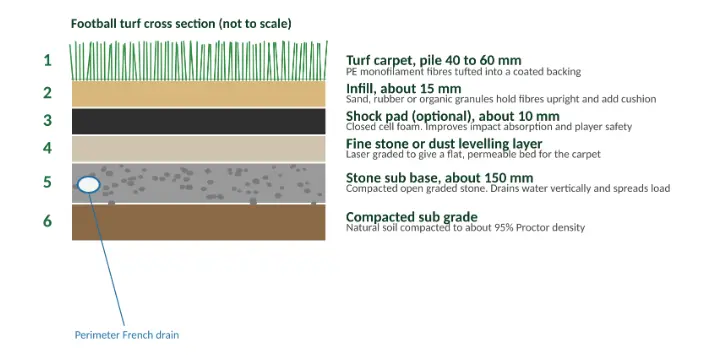
Football Turf Layers
- Compacted sub grade: about 95% Proctor density.
- Stone sub base: about 150 mm of open graded stone.
- Levelling layer: fine stone or dust, laser graded.
- Shock pad (optional): about 10 mm of closed cell foam.
- Turf carpet: fibres tufted into a coated backing.
- Infill: about 15 mm of sand, rubber or organic granules.
Football Turf Materials
Fibers
PE monofilament is the most common choice. Polypropylene suits budget fields and nylon suits high wear zones.
Pile Height
Football turf usually has a 40 to 60 mm pile. Taller pile holds more infill and feels softer.
Backing and Coating
Primary and secondary backing, sealed with latex or PU, locks each tuft in place. Weak coating means shedding fibres.
Infill Options
Sand, rubber and organic infills change cushioning and heat.
Shock Pads and Drainage Layers
Shock pads cut injury risk. Pair them with layers that drain faster than 300 mm per hour.
FIFA Quality and Quality Pro
FIFA Quality suits community play and Quality Pro suits professional matches. Both need lab and field tests, so check FIFA’s public register. Our FIFA turf vs regular turf guide explains more.
Ask every turf supplier
- Is this exact product on FIFA’s public list?
- What fibre, pile height and backing weight do you quote?
- How much infill per sq m, and which type?
- What do the warranty and test reports cover?
Football Turf Installation Process
Football turf installation follows ten steps in one fixed order.
1. Site Clearing and Marking
Clear the site, then mark boundaries, levels and drain lines from the approved drawing.
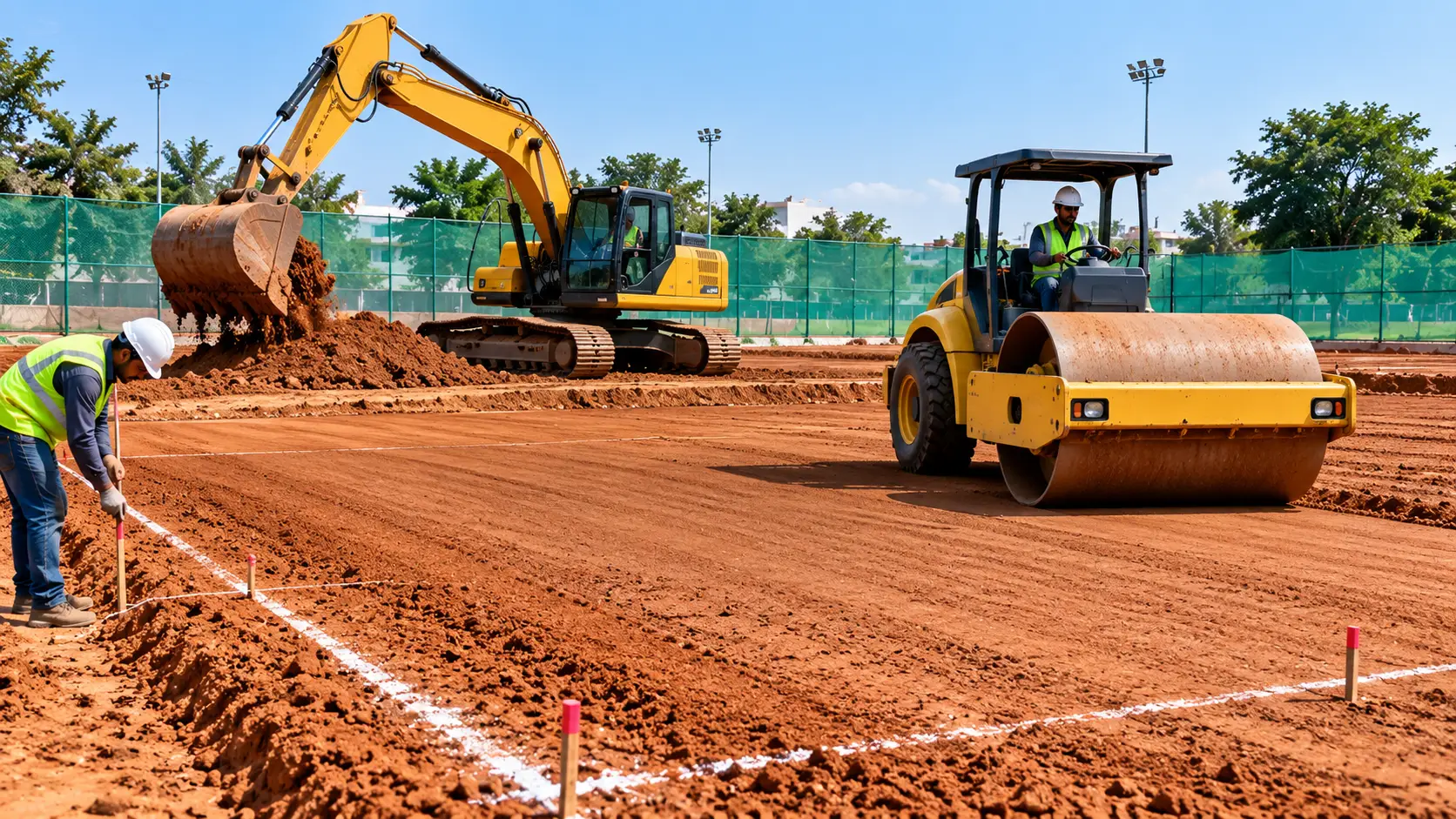
2. Excavation and Compaction
Excavate to formation level and compact the sub grade to about 95% Proctor density.
3. Drainage
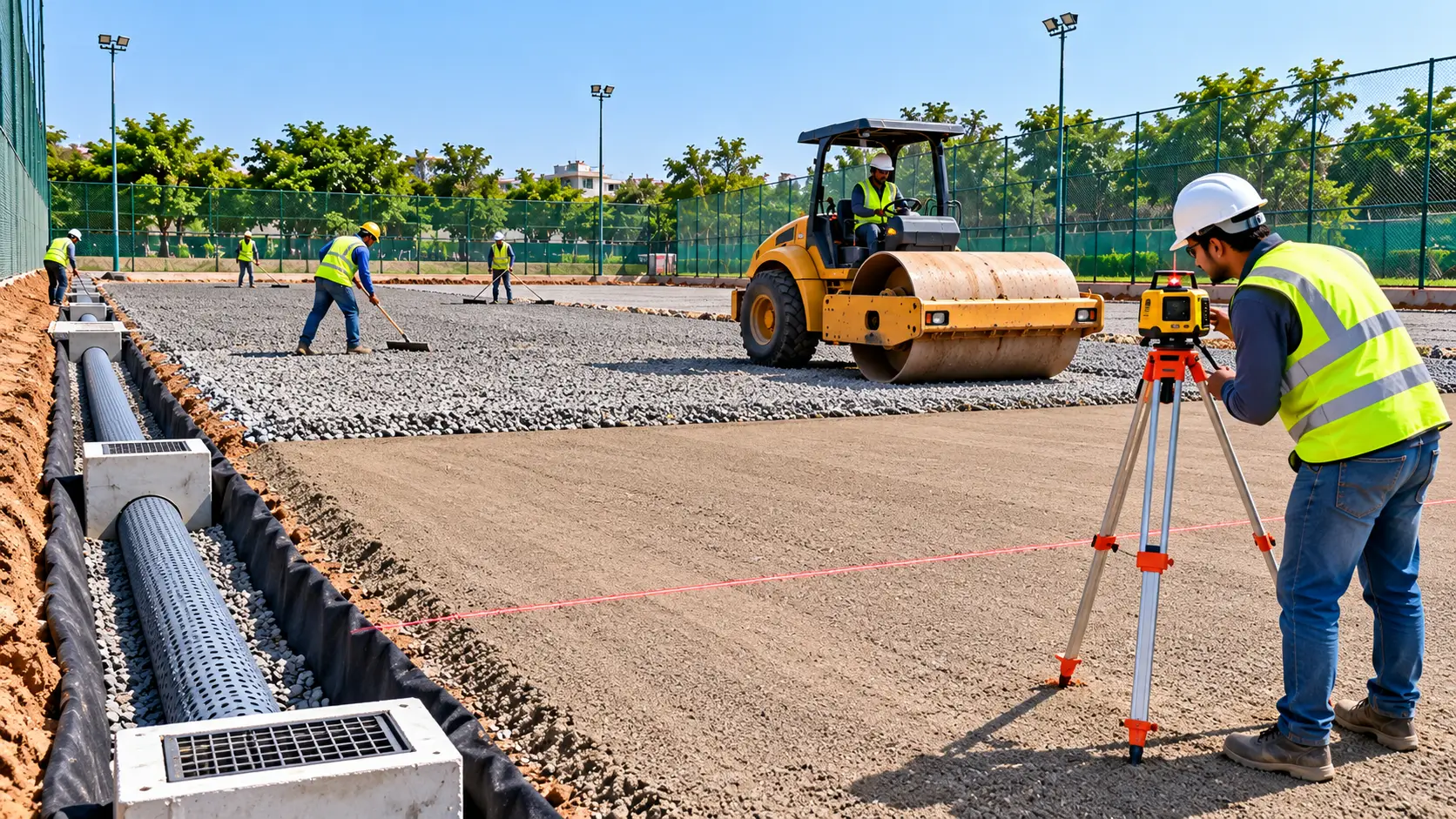
Lay perimeter French drains and outlets. Check falls before any base goes on.
4. Sub Base
Spread and compact about 150 mm of open graded stone in layers.
5. Levelling and Laser Grading
Spread the fine layer and laser grade it to the specified falls.
6. Shock Pad
Roll out the pad, tape the joints and check for gaps.
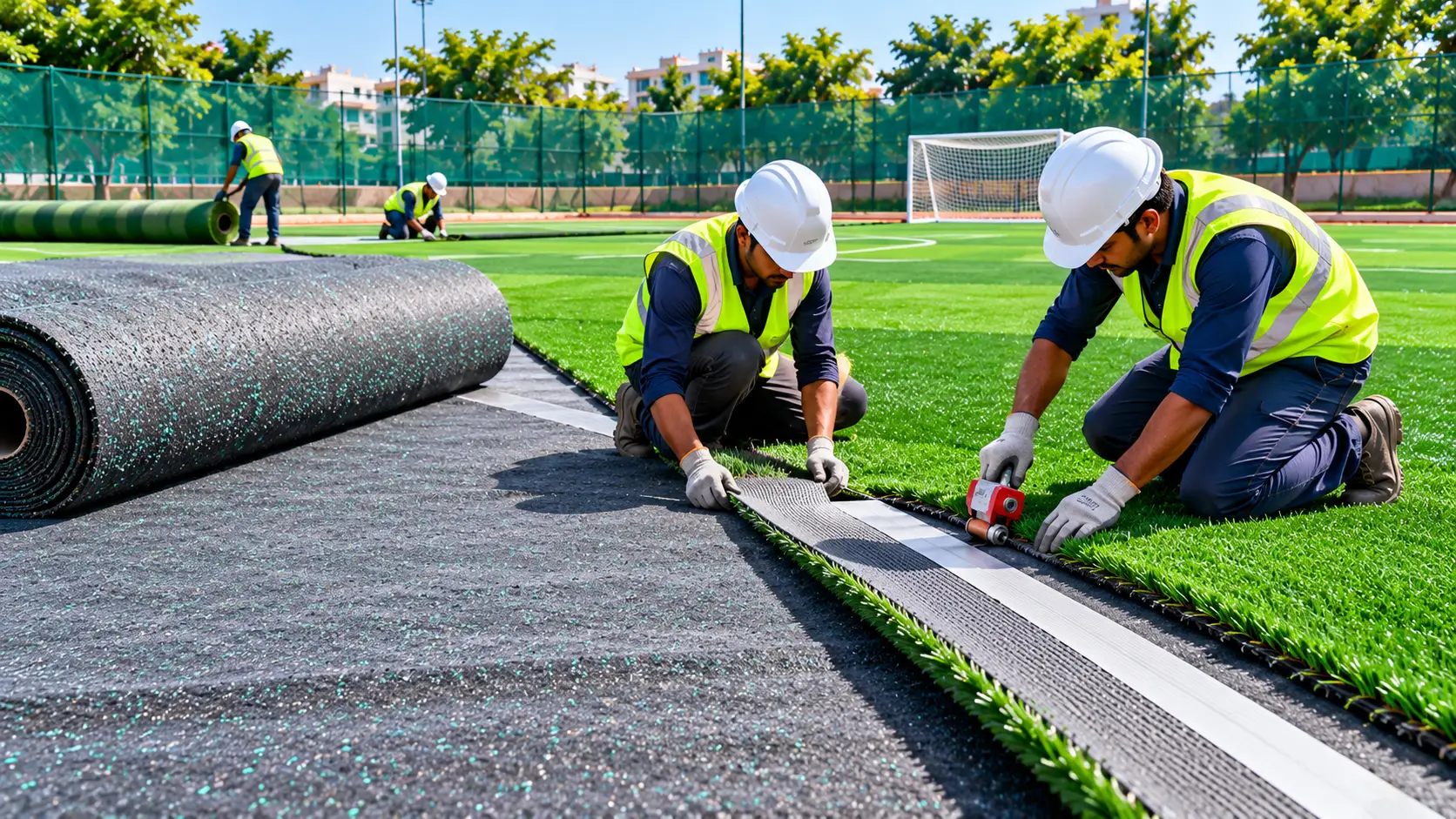
7. Turf Rolling, Cutting and Seaming
Roll out the carpet, trim it and join seams with tape and adhesive.
Why Choose The Sports Habitat for Pickleball Courts
- Three pickleball courts on ITF approved Courtsol France acrylic at Ekya School, Byrathi.
- Pickleball for Shridevi Institutions and multi sport PP tile courts at Amrita.
- CAD layouts and 3D visualisation before work begins.
- 12 months of complimentary maintenance after handover.
Conclusion
Remember two numbers: 20 × 44 ft for the court and 30 × 60 ft for the plot. Fencing, lighting and surface choices all build on them. Get those right on paper and the rest of the project becomes far easier to price and deliver.
Frequently Asked Questions
About 30 × 60 ft (1,800 sq ft) in total, including run off.
At least 18 ft (5.5 m) of clear height.
Roughly Rs 4.5 to 9 lakh outdoors and Rs 10 to 15 lakh or more indoors.
Only if it is level, firm and large enough for the full 30 × 60 ft footprint. Most driveways are too small.
Yes. A full basketball court of about 50 × 84 ft can often take two pickleball courts with tight run off.
One court needs about 1,800 sq ft. Four courts need about 7,200 sq ft.
About 167 sq m for one court. The playing area alone is about 82 sq m.
Three comfortably (about 502 sq m). Four need about 669 sq m.
The same 30 × 60 ft footprint plus entry space, under an 18 ft ceiling.
The net is 36 in at the sidelines and 34 in at the center. Indoor ceilings should be at least 18 ft.
6.1 m × 13.41 m.
Yes, up to four on a 60 × 120 ft area. Run off to the fence is tight: about 5 ft at the sides and 8 ft at the ends.
The playing area stays 20 × 44 ft. For total space, treat 30 × 60 ft as the practical minimum.