
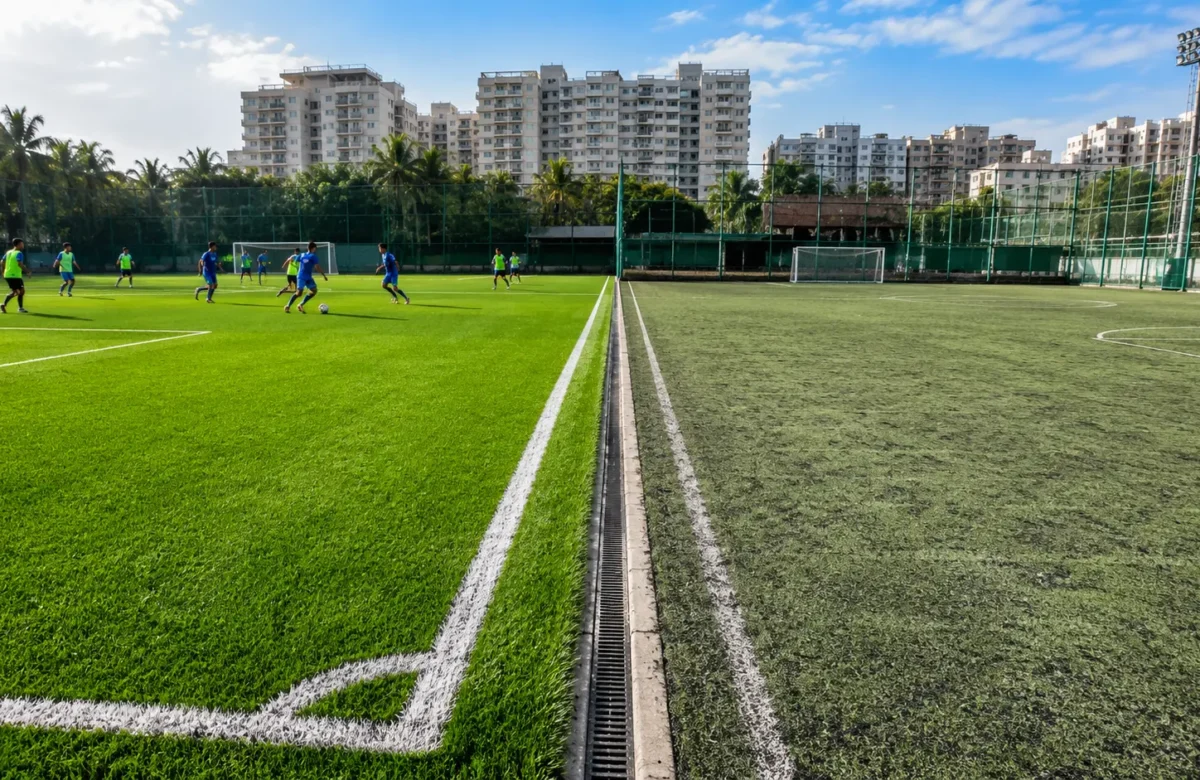
FIFA turf vs regular artificial turf: compare quality, durability & certification. Includes installation costs & providers in Bangalore.
FIFA Turf vs Regular Artificial Turf: What’s the Real Difference?
Here’s a claim worth testing next time you’re shown a turf sample: “This is FIFA-grade.” Walk into most turf showrooms in India and you’ll hear it constantly, usually attached to products that were never anywhere near a FIFA test lab. That gap between marketing language and actual FIFA approved turf is exactly where buyers get burned, either paying a premium for nothing or installing a bargain product they think is certified when it isn’t. Let’s sort out what’s real.
So What Actually Is FIFA Turf?
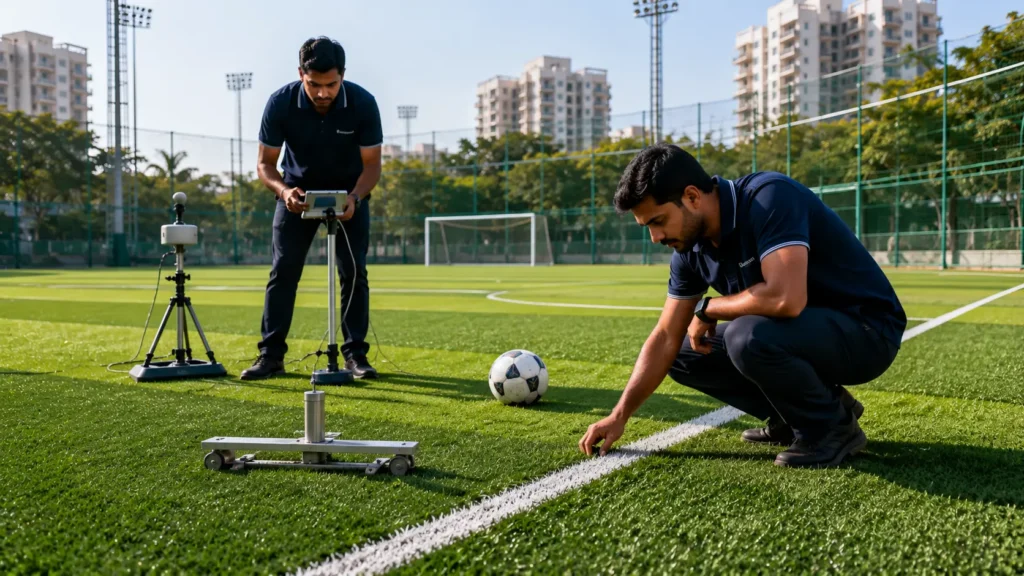
Not a marketing term. FIFA turf refers specifically to artificial grass tested and approved under the FIFA Quality Programme, launched in 2009. There are two tiers: FIFA Quality, for community and amateur pitches (formerly the 1-Star mark), and FIFA Quality Pro, for professional and international competition (formerly 2-Star). Getting either one means passing independent laboratory testing across 22 performance parameters, including ball roll, ball rebound, shock absorption, vertical deformation, rotational resistance, and surface temperature, followed by on-site field testing after installation.
Here’s the part suppliers rarely mention: there’s no partial pass. A product that clears 20 of 22 parameters still fails certification entirely. FIFA maintains a public registry of approved products, and if a turf isn’t listed there, it isn’t fifa certified turf, no matter what the invoice or the sales pitch says.
And Regular Artificial Turf?
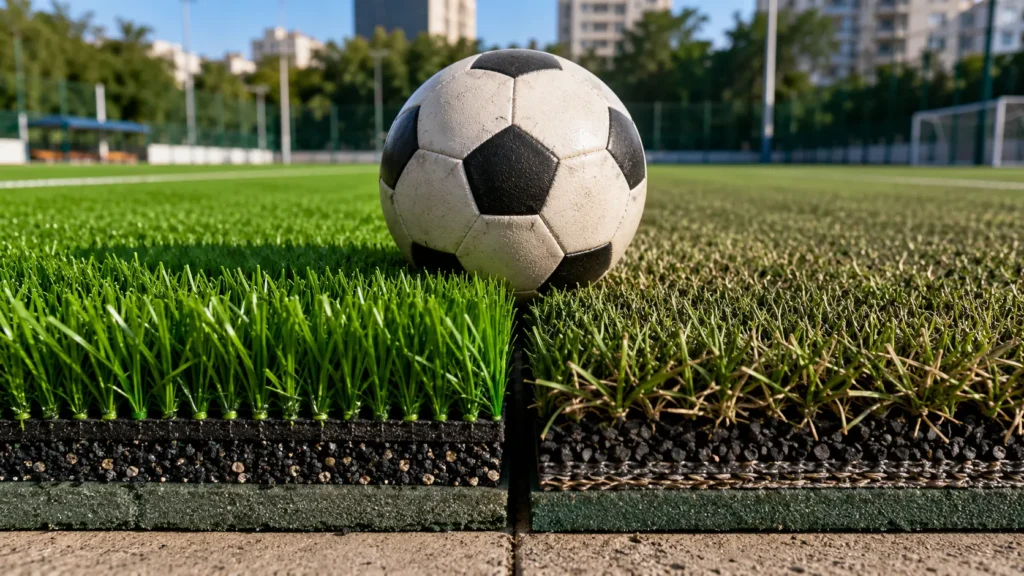
Perfectly reasonable, for the right use case. Regular artificial turf is general-purpose synthetic grass with no independent testing body behind it, which makes it a sensible choice for recreational grounds, backyard setups, and multi-purpose school courts where match-grade ball behaviour was never the priority. The problem isn’t that regular turf is inferior across the board. It’s that “artificial turf” and “fifa football turf” get marketed as interchangeable terms when they describe two entirely different product categories.
Where They Actually Diverge
| Factor | FIFA Turf | Regular Artificial Turf |
|---|---|---|
| Certification | FIFA-tested, publicly listed | None |
| Testing | 22 lab and on-site field parameters | Not independently tested |
| Durability | About 8 to 10 years, heavy use | About 3 to 5 years typical |
| Ball roll and bounce | Consistent, grass-like | Varies by batch |
| Shock absorption | Tested to FIFA safety thresholds | Not standardised |
| Cost | Certification adds roughly 15 to 30% to surface cost | Lower upfront |
| Best fit | Academies, clubs, competition venues | Recreational, school, casual five-a-side |
Do You Actually Need It?
This is the honest question most suppliers skip. If you’re hosting AIFF- or state-federation-sanctioned matches, or running a serious academy competing on player development, FIFA Quality, or Quality Pro for top-tier competition, is the right call. If you’re building a recreational school ground, an apartment amenity, or a casual pay-and-play arena, regular turf is genuinely fine, and the certification premium there buys a label nobody in that context needs.
What Installation Actually Involves
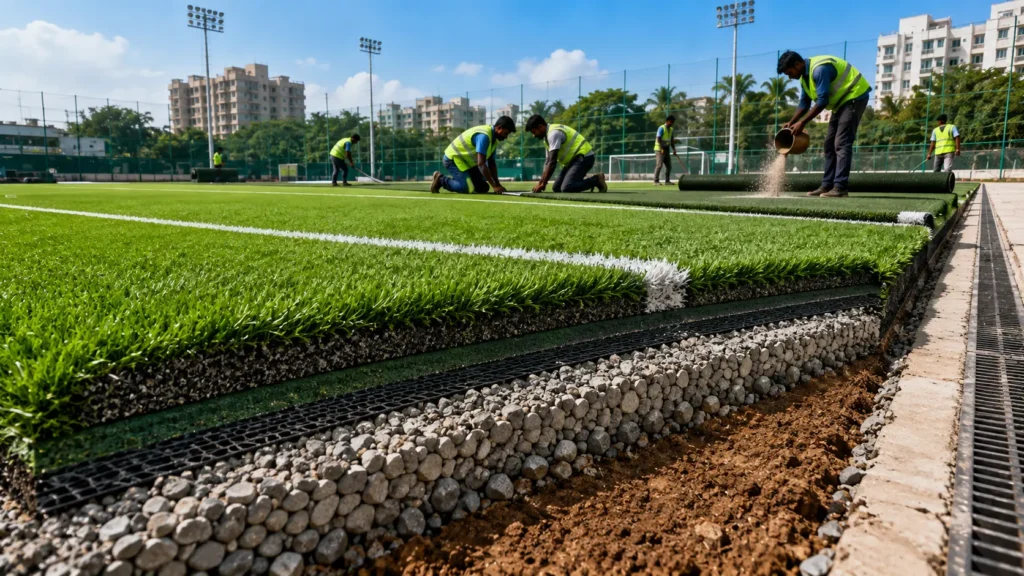
Site preparation and grading, sub-base compaction, a shock pad where specified, turf laying and seaming, sand or rubber-crumb infill, line marking, and, for certified installs, an accredited field test once the pitch is complete. That last step is what most corner-cutters skip, and it’s exactly why “FIFA-grade” claims so often turn out unverifiable when you ask for the paperwork.
The Real Price Gap
Regular artificial turf installs at roughly ₹200 to 450 per sq. ft., depending on pile height and infill type. FIFA certification adds roughly 15 to 30% to the surface cost alone, not the full project, and on a full-size pitch, FIFA Quality Pro can add ₹10 to 20 lakh over a standard system. A complete FIFA Quality football ground, around 7,000 sq. m, including base preparation, drainage, fencing, and lighting, typically runs ₹1.2 to 2.4 crore in India as of 2026.
Getting It Installed in Bangalore
Bengaluru’s academy and corporate-ground market has driven real demand for certified turf, running alongside a much larger recreational five-a-side market that doesn’t need it at all. The Sports Habitat supplies and installs FIFA-approved synthetic turf systems, complete with backing, infill, and shock-pad layers, both as standalone supply-and-install and as part of full turnkey ground builds.
How Not to Get Fooled by an Installer
Check the product against FIFA’s public registry yourself; don’t take a supplier’s word for it. Ask for the post-installation field test report, not just the manufacturer’s lab certificate. A genuinely certified product can still be installed badly, and only the field test catches that gap. Get maintenance terms in writing before you sign anything.
Maintenance Doesn’t Discriminate
Brush regularly to prevent fibre matting, top up infill annually, and keep drainage channels clear. Certified turf only holds its certified performance if it’s maintained to spec; skip the upkeep and you erode precisely the properties you paid the certification premium for in the first place.
Quick Answers
Passing all 22 lab and field tests under the FIFA Quality Programme, and appearing on FIFA’s public registry.
Only if you’re hosting sanctioned matches or running a competitive academy. Otherwise regular turf wins on value.
- Roughly 8 to 10 years under heavy use with proper maintenance, against 3 to 5 years typical for regular turf.
- Yes. The Laws of the Game permit FIFA Quality and FIFA Quality Pro certified turf for competitive play, professional and international fixtures included.
- No. Certification applies to a tested, installed system as a whole. You’d replace the surface with a certified product and pass field testing, not upgrade what’s already down.
The Takeaway
FIFA certification isn’t a sticker you slap on for credibility. It’s a specific, testable standard that matters enormously on a competition ground and buys almost nothing on a recreational one. Figure out which one you actually need, then talk to The Sports Habitat about the right build for your ground.
Not Sure Which Turf Is Right for Your Facility?
Get expert guidance from TSH on choosing between FIFA-approved and regular artificial turf — matched to your budget, usage, and performance needs.