
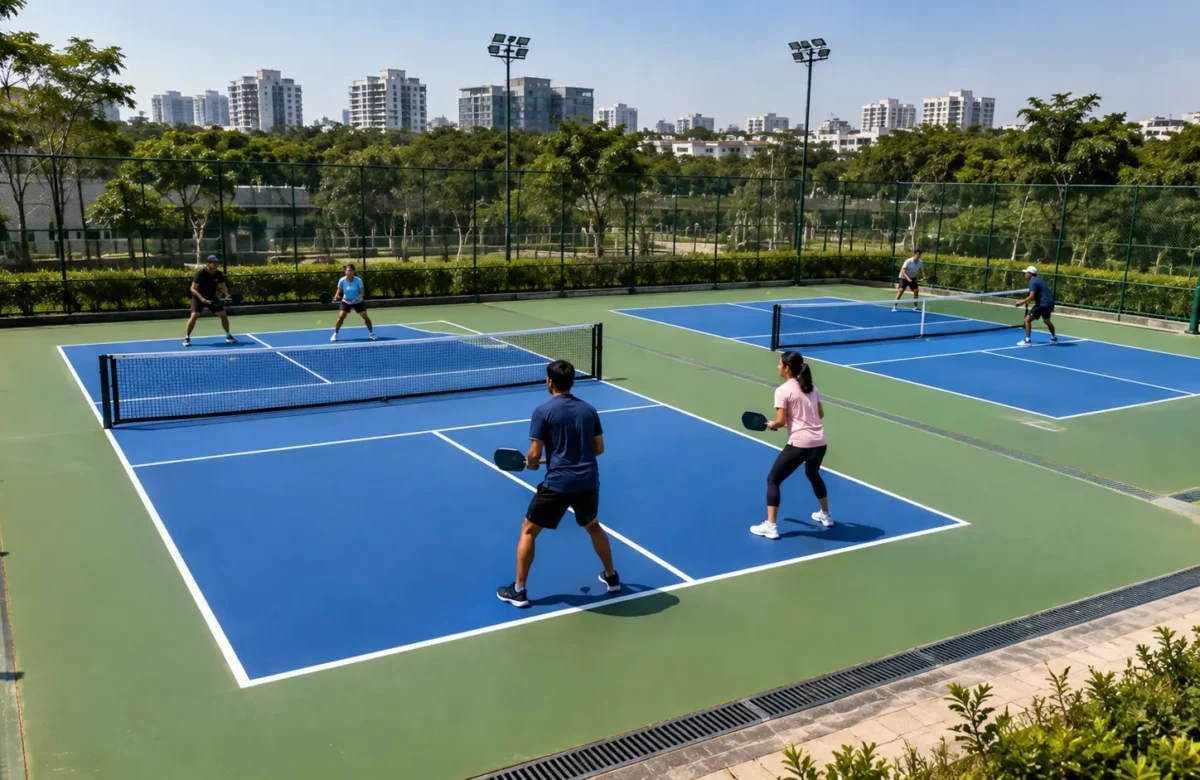
Pickleball Court Installation Guide: Everything You Need to Know (India, 2026)
India had roughly 200 operational pickleball courts in early 2024. By mid-2025, that number had jumped to around 1,200, and new courts keep showing up every few weeks in Mumbai, Bengaluru, Delhi NCR, and Hyderabad. Apartments, clubs, schools, and corporates are converting underused tennis and badminton courts about as fast as contractors can resurface them. If a pickleball court installation is next on your list, here’s everything you need to know, in the order you’ll actually need to know it.
1. Know Your Numbers First
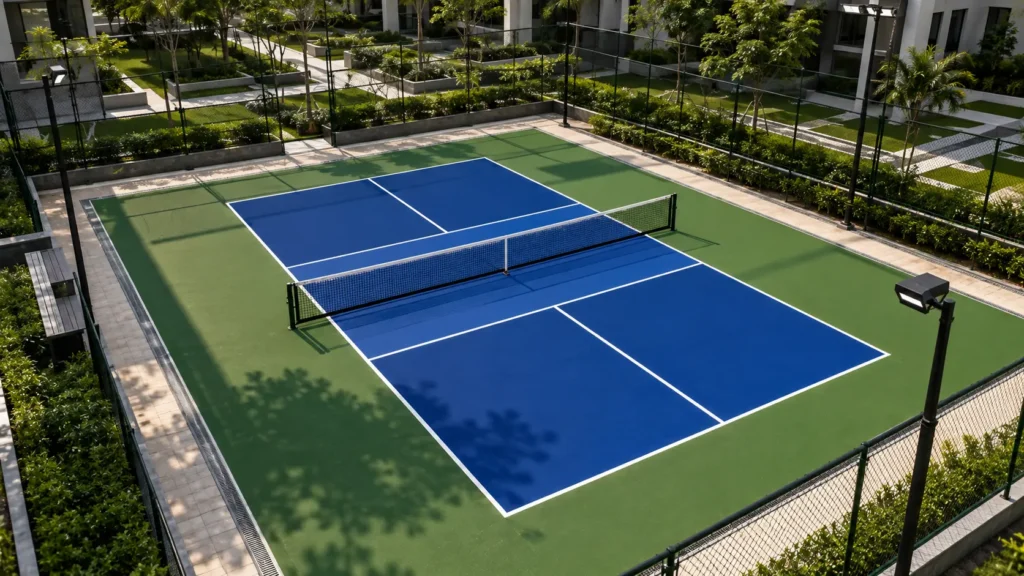
The official USA Pickleball dimensions are 20ft × 44ft (6.1m × 13.4m) for the playing court, identical for singles and doubles, unlike tennis. The kitchen, or non-volley zone, extends 7ft from the net on each side across the full 20ft width. The net sits 36in high at the sidelines, dipping to 34in at the centre. Each side has two 10ft × 15ft service courts split by a centreline, and all lines are 2in wide. Budget a minimum total footprint of 30ft × 60ft (1,800 sq. ft.) once you add safety run-off; competitive venues prefer 34ft × 64ft (2,176 sq. ft.). These numbers apply worldwide, indoors or outdoors. What changes between indoor and outdoor isn’t the measurements, it’s the surface and the structure around it.
2. Decide Indoor or Outdoor Early
Outdoor is cheaper and faster to build, but it needs UV-stable acrylic and solid drainage to survive Indian monsoons. Indoor costs more upfront, structure, roofing, and overhead clearance for lobs all add real expense, but it delivers consistent bounce and year-round bookings regardless of weather. For anyone chasing rental income, that weather-independence is often the whole business case.
Three groups are driving most of the demand right now: apartment communities adding a court to the clubhouse amenity list, corporate campuses looking for a low-footprint recreation option, and schools that want something more social than a single badminton court can offer. Each of these tends to land on a different answer to the indoor-outdoor question, mostly based on how much land they have to spare.
3. Pick a Floor That Matches How It’ll Be Used
- Standard acrylic, two-coat. ₹350 to 600 per sq. ft. installed, 1 to 2 weeks including cure time. The default choice for most outdoor courts in India.
- Cushioned acrylic, multi-coat. Adds ₹60,000 to 1.2 lakh per court over standard acrylic. Worth it on heavy-use commercial courts where shock absorption pays for itself in player retention.
- Modular interlocking tiles. ₹350 to 600 per sq. m, installs in 1 to 2 days with no curing time. Good for indoor conversions and temporary setups, but specify 8mm-plus thickness; thinner tiles bow and separate at the joins within a couple of years.
4. The Build, Step by Step
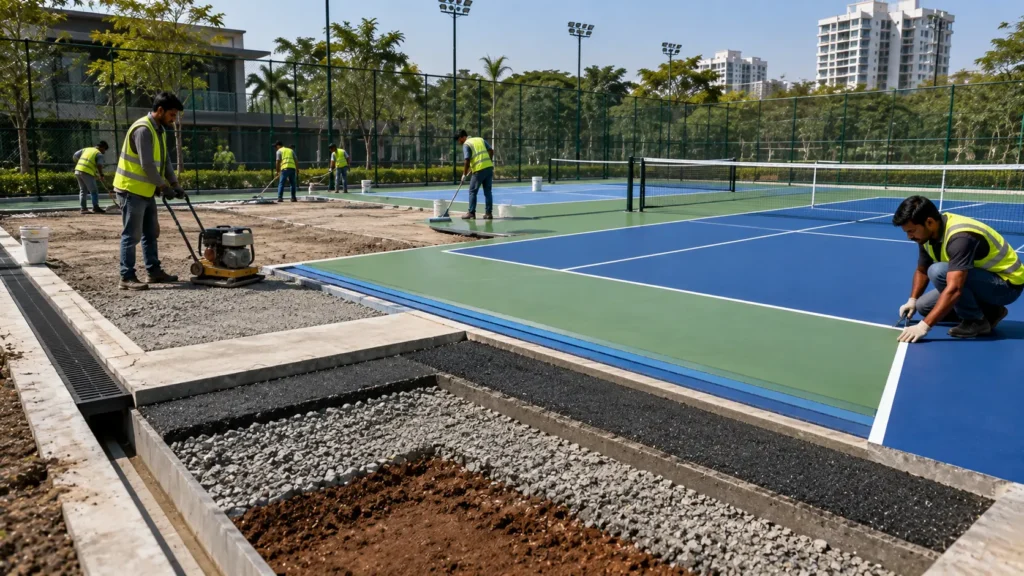
Site assessment, then base and sub-base preparation and compaction, then surface installation (acrylic coating or tile-laying), then line marking, then net and post installation, then fencing for outdoor courts. A single outdoor court typically takes 3 to 5 weeks, and most of that is base curing time you can’t rush.
5. What It’ll Actually Cost
An outdoor acrylic court typically runs ₹4.5 to 9 lakh. An indoor court runs ₹10 to 15 lakh or more, given the added structure and climate control. Metro pricing, Bengaluru included, tends to sit 10 to 20% above tier-2 towns on labour and material logistics alone. The line item first-time builders most often underestimate isn’t the flooring, it’s drainage and base preparation, and cutting corners there shows up as standing water the first serious monsoon.
For anyone building commercially, the payback math matters: with hourly rentals commonly running ₹500 to 1,200 in metro markets, a well-booked outdoor court can recover its construction cost within 12 to 24 months. That’s a big part of why apartment clubs and standalone arenas keep building multiple courts instead of stopping at one.
6. The Fastest Option: Convert, Don’t Build
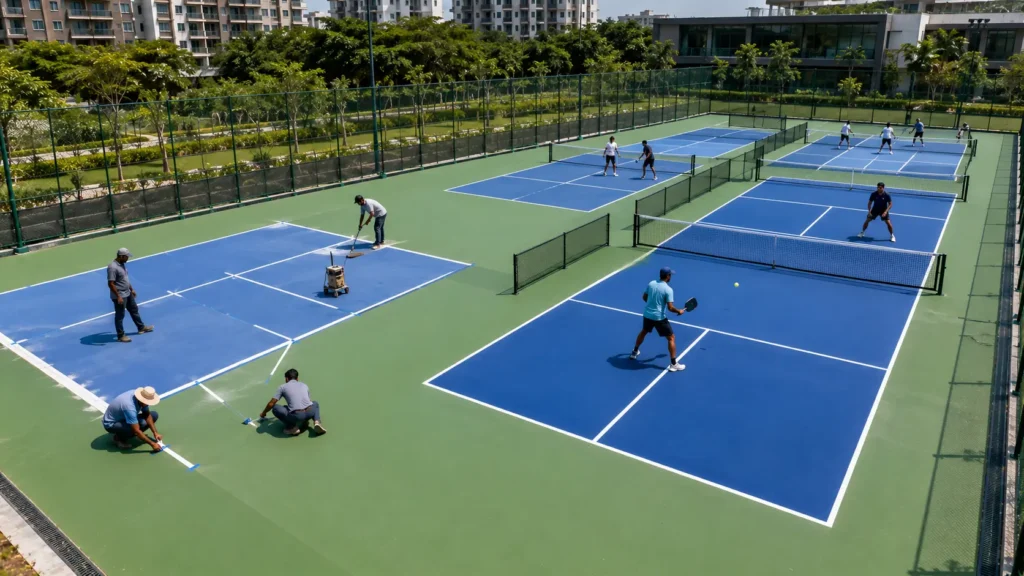
A full tennis court fits up to four pickleball courts side by side, and badminton doubles courts share nearly identical 20ft width, which makes conversion mostly a matter of line marking, net-height adjustment, and fencing rather than a full rebuild. This is exactly how most Indian clubs and apartment complexes are adding pickleball right now, without waiting months for a ground-up build.
7. Vetting a Contractor
Treat “pickleball court contractors near me” or “pickleball contractors near me” results the way you’d vet any construction partner: ask for a portfolio you can visit in person, get flooring thickness and material specs in writing, and check what maintenance support is included after handover, not just what gets promised before the deposit clears.
8. Installation in Bangalore
Bengaluru is one of the cities leading India’s pickleball build-out, with courts turning up in gated communities, IT campus recreation zones, and dedicated clubs. The Sports Habitat installs pickleball courts as part of its multi-sport court surfacing service, including straightforward conversions of existing tennis and badminton courts.
9. Keeping the Court Playable
Sweep and pressure-wash regularly, recoat acrylic every 5 to 8 years depending on usage, inspect net tension and fencing monthly on high-traffic courts, and touch up line markings as they fade instead of waiting for a full recoat.
FAQ - Frequently Asked Questions
The standard size of a pickleball court is 20 ft × 44 ft (6.1 m × 13.4 m).
Building a pickleball court in India typically costs ₹4.5 to 9 lakh for an outdoor court and ₹10 to 15 lakh or more for an indoor court, depending on flooring material, court size, and site conditions.
Yes, up to four pickleball courts fit on one tennis court. Conversion involves re-striping or resurfacing, lowering net heights, and adding dividers between courts making it faster and cheaper than building new.
Cushioned acrylic flooring is the best material for pickleball courts in most Indian climates, offering superior heat resistance, ball bounce consistency, and joint protection for all usage levels.
Most single outdoor pickleball court installations take 3 to 5 weeks, with the bulk of that time going toward base curing rather than active construction work.
READY TO BUILD YOUR PICKLEBALL COURT?
Get a free site assessment and personalized quote from our pickleball court installation experts. From flooring selection to final line painting, we handle every step on time and within budget.