
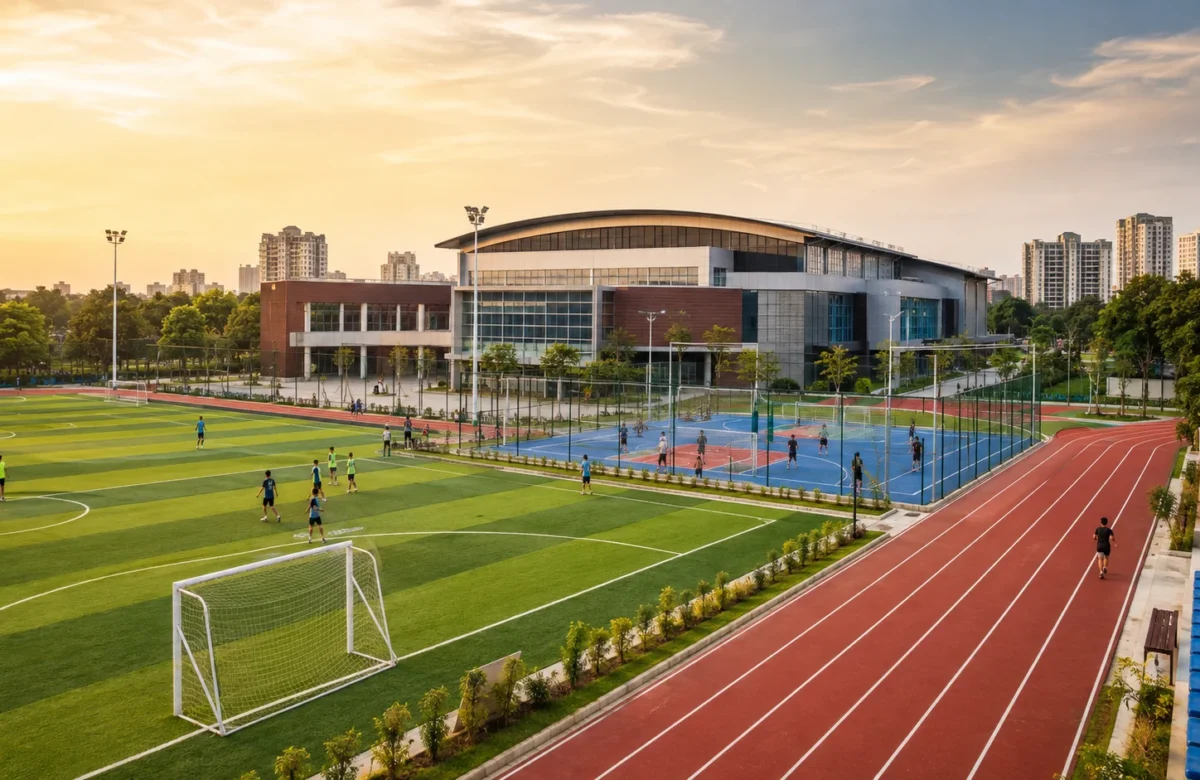
What Counts as Sports Infrastructure
Sports infrastructure in India covers every physical asset that supports organised play: synthetic and natural turf grounds, indoor and outdoor courts (basketball, badminton, tennis, volleyball, pickleball), athletic tracks, multi-sport complexes, and the lighting, fencing, seating, and drainage that keep them usable year-round. Sports infrastructure development is the umbrella process tying it together, from site assessment through design, construction, certified surfacing, and maintenance. Skip any one stage and the facility underperforms. Brilliant flooring on a poorly drained base fails within two monsoons, no matter how good the material was on paper.
Who’s Actually Building This Right Now
Three buyer types dominate the market, each with different priorities:
Schools and colleges
Schools and colleges need play areas, basketball and volleyball courts, and athletic tracks built to federation and safety norms, increasingly non-negotiable as NEP 2020 formalises sport as curriculum rather than extracurricular. Federation-compliant sports facility construction also protects institutions hosting inter-school or district competitions.
Builders and real estate developers
Builders and real estate developers treat pickleball courts, multi-sport decks, and clubhouse courts as genuine differentiators in premium launches across Bengaluru, Mumbai, and Delhi NCR. Sports complex construction done well adds real resale and rental value; done poorly, it becomes a maintenance liability the RWA inherits within a year.
Corporates
Corporates are adding courts and recreation zones to office campuses as retention tools: spaces employees actually use, not brochure filler.
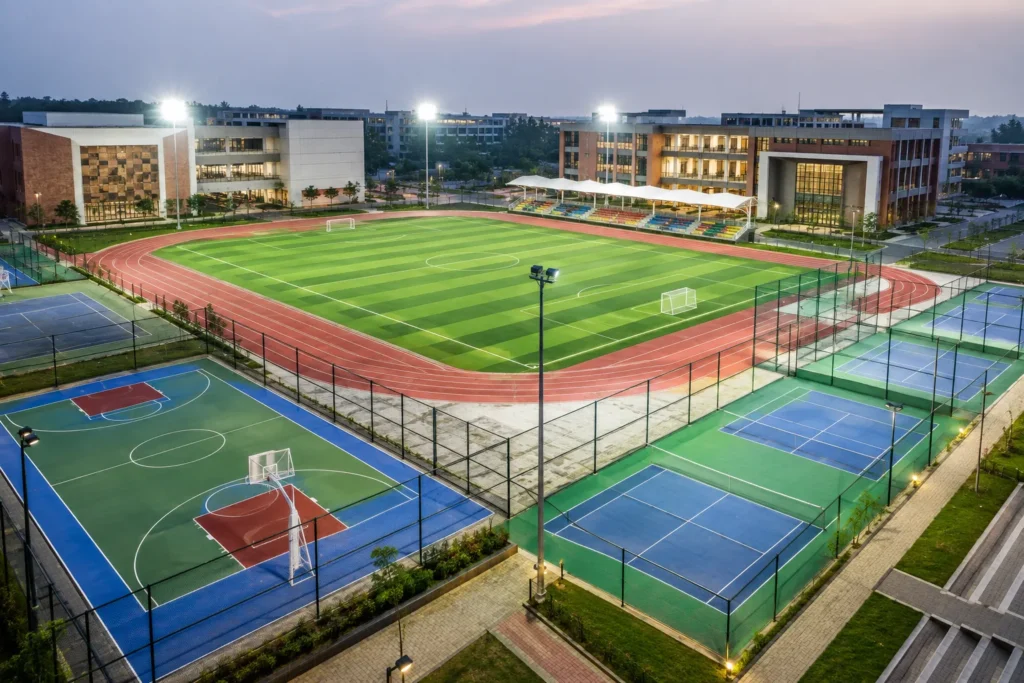
The Main Categories
Indoor and outdoor facilities carry different flooring and structural demands. The categories you’ll run into most: synthetic courts (basketball, tennis, badminton, pickleball) in acrylic or PU; turf grounds for football and cricket practice; IAAF-spec athletic tracks in polyurethane or EPDM; multi-purpose complexes combining several sports under one roof; and fitness or recreational zones for corporate and residential use. The right mix depends entirely on usage intensity. A school court used by forty classes a week needs a different spec than a weekend residential amenity.
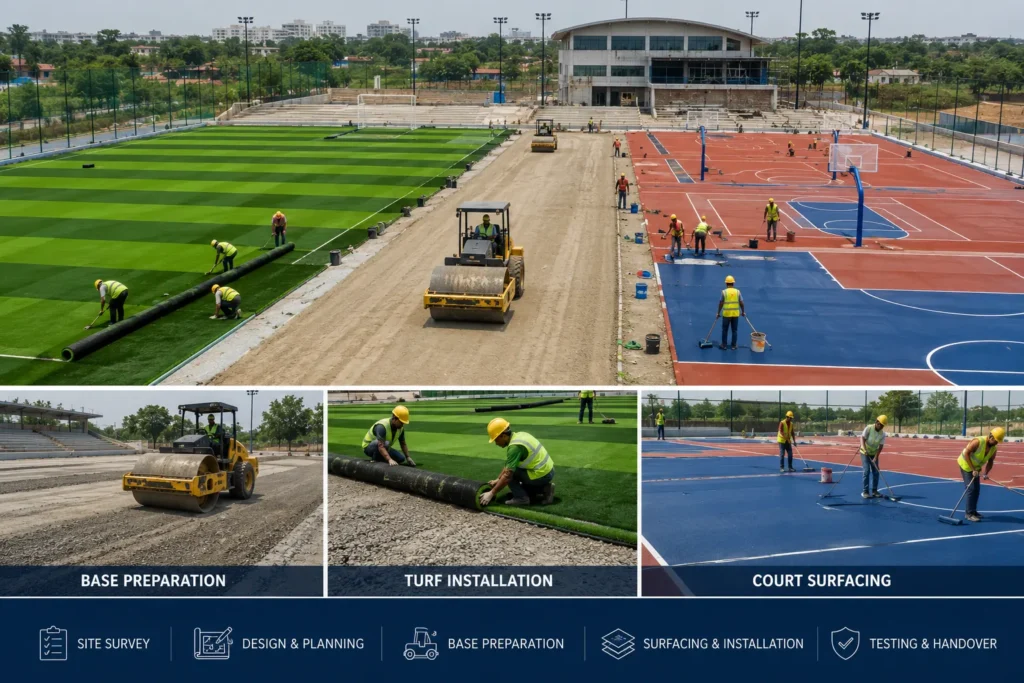
Five Stages, Start to Finish
- Site assessment. Soil, drainage, orientation.
- Design. Layout, sport-specific dimensions, structural plan.
- Material selection. Acrylic, PU, synthetic turf, or EPDM, matched to usage and climate.
- Construction. Civil work, base preparation, surfacing, line marking, fencing, lighting.
- Handover and maintenance. Testing, certification checks, and a maintenance plan from day one, not an afterthought.
What It Actually Costs in 2026
| Facility Type | Typical Cost (2026) | What Moves the Price |
|---|---|---|
| Outdoor acrylic court | ₹4 to 15 lakh | Size, base condition, line marking complexity |
| Indoor court (structure + flooring) | ₹15 to 45 lakh | Ceiling height, roofing span, flooring grade |
| Football-size artificial turf | ₹200 to 450 per sq. ft. | Certification tier, pile height, infill type |
| Small multi-facility setup | ₹30 lakh to ₹1 crore | Number of facilities, changing rooms, land condition |
| Stadium-scale development | Several crores | Seating, broadcast infrastructure, land cost |
These are directional 2026 ranges, not quotes. Get a site-specific estimate before locking a budget; two grounds ten kilometres apart can price 30% apart on soil condition alone.
How to Choose the Right Sports Infra Company
- Check the range, not just the highlight reel. A track record across the sport types you actually need matters more than one flagship project photo.
- Visit a live site. Ask for a project you can walk through in person, not just render images.
- Verify certified sourcing. FIFA, ITF, IAAF, and BWF-compliant systems, not vague “international standard” claims.
- Get warranty terms in writing. Verbally promised warranties are not warranties.
- Ask what happens after handover. A sports infra company that disappears once the concrete cures leaves you managing turf wear and lighting failures alone. Twelve months of complimentary post-handover maintenance is a real signal that a contractor stands behind its own work.
Bengaluru’s IT campuses, gated communities, and international schools have made it one of India’s densest sports infrastructure markets, driven by corporate wellness budgets, builder amenity competition, and a school system under pressure to formalise sport. The Sports Habitat, headquartered in Vasanth Nagar, Bengaluru, works across this exact mix: turnkey builds for institutions like GITAM University and Amrita International Vidyalayam, consultation and planning for clubs like NAFL Jakkur, and design-to-civil delivery for corporate campuses like ITC’s Green Center.
Finding a Contractor Near You
Searching “sports court builders near me” or “sport court contractors near me” turns up dozens of names. Vet them the way you’d vet any construction partner: three references you can call directly, confirmed certified material partnerships rather than whatever’s cheapest that week, and a written scope before anything is signed.
Keeping It Alive: Maintenance Basics
Courts and turf degrade fastest from neglect, not use. Pressure-wash acrylic courts monthly, top up turf infill annually, check lighting and fencing structurally every six months, and recoat acrylic every 5 to 8 years depending on footfall. A facility built well and maintained on schedule easily outlasts one built cheap and left alone.
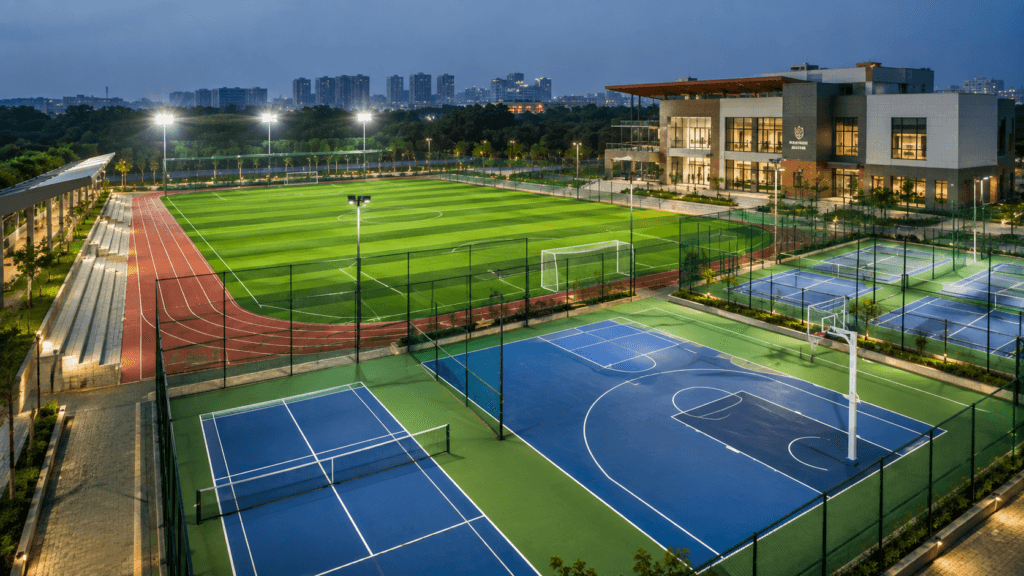
TSH delivers turnkey projects with single-point accountability: design, civil work, certified surfacing, lighting, and fencing under one contract, not four vendors pointing fingers at each other. Every project includes twelve months of complimentary maintenance, with FIFA, ITF, IAAF, and BWF-certified systems available as standard.
Frequently Asked Questions
Anywhere from ₹30 lakh for a basic single-turf, single-court setup to several crores for a stadium-scale facility. Size, material, and location decide most of the variance.
Standardised safety and material certification, dedicated maintenance budgets rather than construction-only budgets, and closer alignment with schemes like the revamped Khelo India programme, which now actively courts private co-investment.
Synthetic acrylic. It’s UV- and weather-resistant, built to survive Indian monsoons, and far lower-maintenance than wood or plain concrete.
A single outdoor court: 3 to 6 weeks. A full turf ground or multi-court complex: 2 to 6 months, depending on scale and approvals.
Most projects need local municipal building plan approval; larger complexes may also need a fire safety NOC and, for bigger land parcels, environmental clearance. Confirm requirements with your local authority before breaking ground.
Sports infrastructure in India is having its moment, backed by a ₹36,441 crore government push and rising demand from schools, builders, and corporates alike. The difference between a facility that lasts a decade and one that needs rework in two years comes down to who builds it. Talk to The Sports Habitat about scoping your project.
Ready to Build Top-Quality Sports Infrastructure in India?
From flooring to fencing, The Sports Habitat delivers complete sports infrastructure solutions; courts, materials, and installation built for durability and performance across India.